17/09/17: Karimabad – Sost

Distance: 67 miles – Travelling time: 2 hours 20 minutes

20170917_081723

The Baltit Fort, Karimabad, Hunza

A leisurely day ahead in terms of driving, our target was to get to the customs post of Sost, on the banks of the Khunjerab River, late in the afternoon to be ready to clear customs and immigration and get the papers to export the car out of Pakistan first thing the following morning so that we would have plenty of time to clear through Chinese customs; a two step process with a 160km drive between two immigration posts once in China.

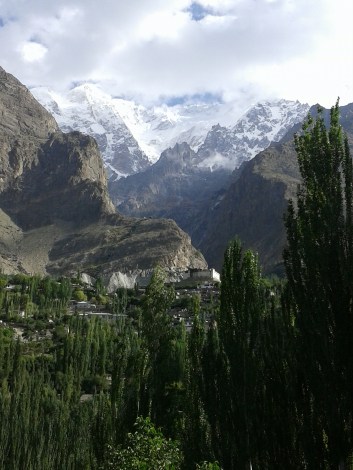
We woke to a beautiful day of clear blue skies and whilst having breakfast we caught a glimpse of the top of Rakaposhi, at last, through a window in the clouds shrouding the mountain. The views were spectacular all around. From the Eagles Nest (Robin – N.B. no apostrophes are used here!), after a very challenging climb in the car up steep narrow tracks (both car and Murray did extremely well!), to the Altit Fort, the surrounding scenery is astounding. It is easy to imagine the people of Hunza throughout history protecting their lands from the vantage points of their forts and hilltops. Truly the terrain the Great Game.

Views across the Hunza Valley

20170917_115430

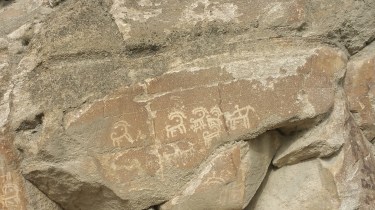
Departing Karimabad we stopped briefly at Haldeikis, the Hunza Sacred Rocks, to see the 7th century rock carvings of ibex and men of horse back – I was slightly skeptical as there were also smatterings of “Ali woz ‘ere” inscribed next to the rudimentary ibex!

20170917_134138

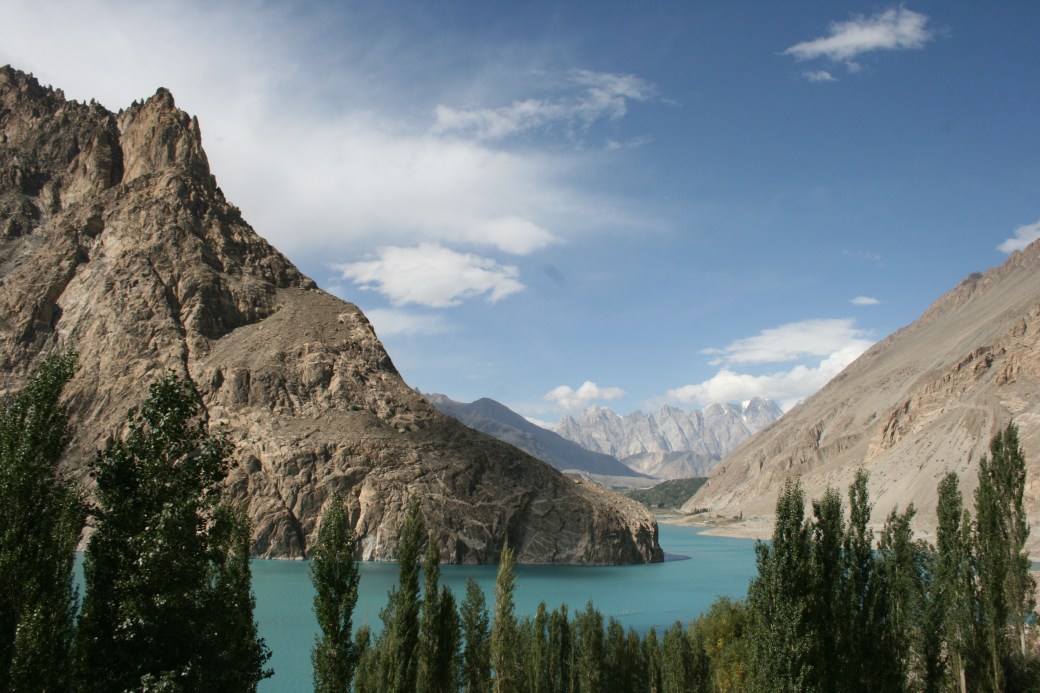
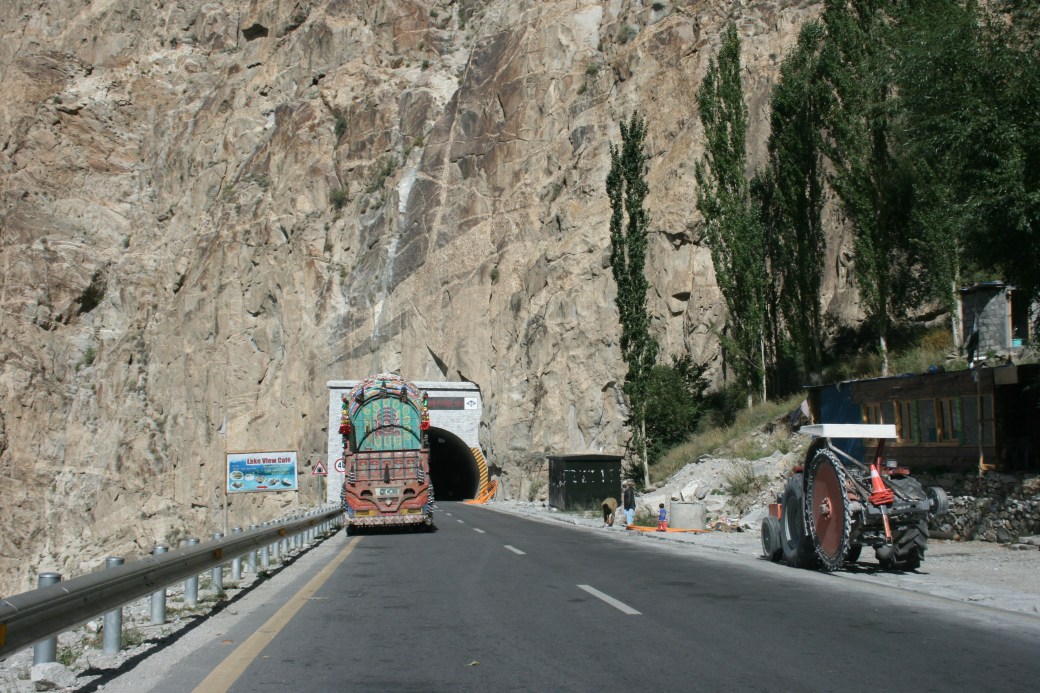
The drive to Sost is possibly the most beautiful and stunning road I have ever driven. The mountains of the Karakorams are various and mighty and the light ever changing, with a hint of autumn the trees are just turning colour and the water in the rivers a beautiful but turbid turquoise blue. The road surface was excellent and we made good progress up the KKH to the surreal Attabad lake with exquisite turquoise waters, through 8km of tunnel (all unlit and some with workmen – completely in the dark! Terrifying to come across at close range, without notice) and on past the Passu and Batura glaciers to arrive in the mid afternoon at Sost.

IMG_1743

Attabad Lake

IMG_1745

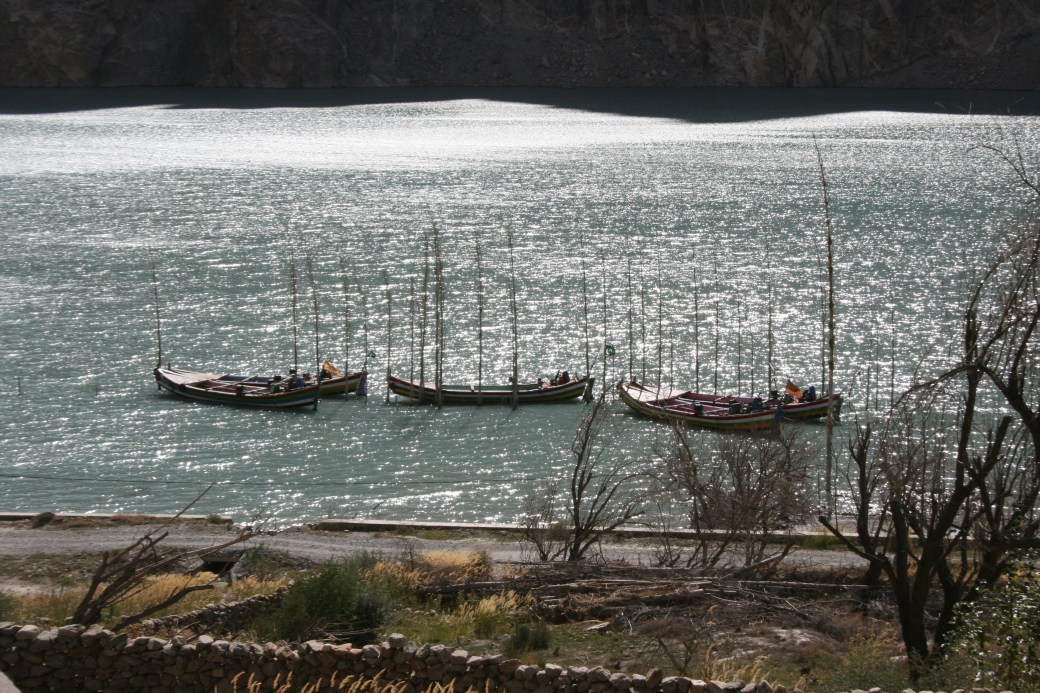
Old boats on Attabad Lake

IMG_1744

Entering the first of the 5 tunnels taking us through 8km of mountain

16/09/17: Naran – Karimabad

Distance: 200 miles – Travelling time: 0630 – 1710 – Temperature range: 6 – 31°C
IMG_1639-min

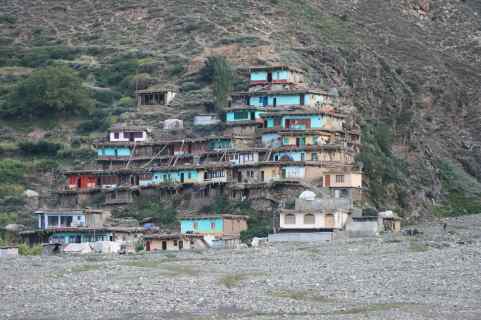
A village clinging to the hillside – it was unusual to see coloured walls

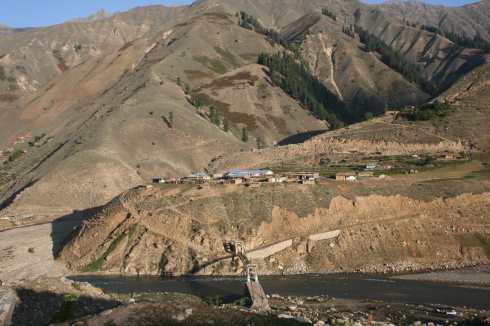
Setting off from our riverside lodgings at 0630 we headed back up the valley with a degree of thrill and some trepidation towards the climb up to Babusor. The views were breath taking in the early morning, if chilled, sun. Murray drove the car very skillfully up the endlessly winding and climbing pass until we reached the police check point marking the end of the KPK and the start of Gilgit Baltistan (GB) – the true Northern Areas and the start of the Karakorum mountain range.
IMG_1643-min

At the Babusor Pass checkpoint we were tersely instructed by the guards to pull over and a short interrogation began. Our papers were checked, and re-checked, and a book was dutifully filled out with our details before we were instructed to sit down and drink truly filthy sweet chai and to eat fried chapattis, again it was best not to think too much about it! The police were incredibly hospitable and kind. Thanks to Murray’s great forethought we were carrying booklets from the British High Commission ‘Shared History, Shared Future; 70 years of Pakistan and UK relations’ – filled with photos and received with ‘aahhhs’. Inspired!

Murray using his charms to placate less than friendly guards. Result: an accompanied breakfast!

Descending the Babusor Pass with some relief after our steep and isolated ascent we entered Gilgit Baltistan. The landscape changed immediately with clusters of houses clinging to cliff faces, red rooftops and patches of beautiful terracing fed by clever irrigation channels. The men here wear the traditional pakol hat (rather like a pancake with a rolled rim), now much in evidence. We wound our way down through the hairpin bends on pretty good road surfaces until we reached the Chilas intersection with the KKH. After a short stop at the check point we were issued with passes from the GB police to see us through all the check points until the boarder crossing at Dih, deep in the Khunjerab National Park.
2017-09-16 09.20.08

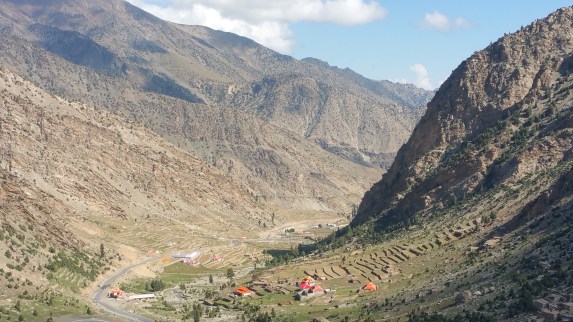
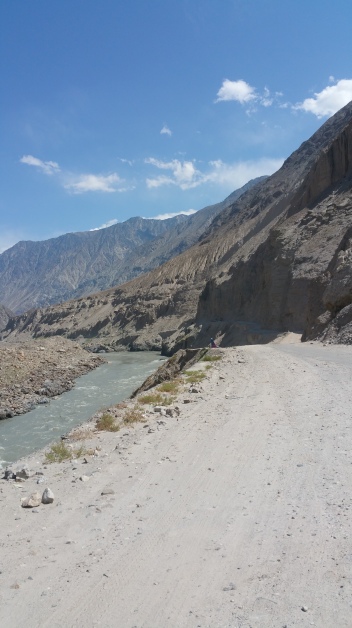
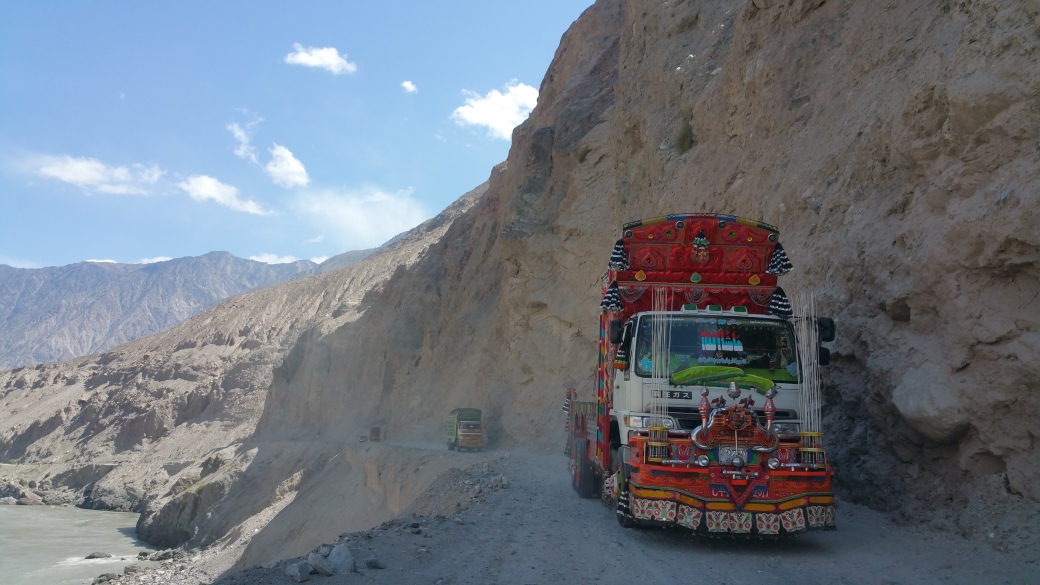
Joining the KKH was a rude awakening! With little metalled road it was a slow and white knuckle inducing ride throughout, negotiating locals driving at relative speed and jingly trucks often at pinch points all the while with a sheer drop into the mighty Indus River far below – and not much of a crash barrier for protection. Halfway between Chilas and Gilgit we crossed the Indus over a new bridge and here the road surface improved immeasurably and we were able to make good progress, sighting the mountain Nanga Parbat behind us and the convergence of the Himalayas, the Karakorum and Hindu Kush ranges, to the point where we branched off, still on the KKH, towards Hunza up the Nagar Valley.
20170916_113227

2017-09-16 11.34.14

2017-09-16 12.43.06

At the confluence of the rivers Gilgit and Indus where the mountain ranges collide

The engineering of the KKH is a remarkable feat of human engineering pitted against the forces of nature. The road follows the Hunza valley in a deep gorge faced by the Hindu Kush mountains to the left and the Karakorum range to the right. Following ancient trails the Chinese began to build the road in the 1960s and 1970s and since then with much human sacrifice, together with the Frontier Works Organisation of Pakistan, and now with Chinese funding the Chinese Pakistan Economic Corridor (CPEC), the road is continuously repaired and rebuilt from the frequent landslides and the metalling of the road has continued all the way to the border with China.

The memorial to the Chinese workers who perished building the Karakorum Highway

We made it to Karimabad in the Hunza district within two hours from Gilgit, having stopped in the village of Ghulmet to have lunch at the Rakaposhi viewing point where we revisited what was our temporary accommodation during the landslides in 2015. This time the weather was beautiful, but a sighting of the summit of Rakaposhi still eluded us! By sheer chance we met Ali, the guide who, with his family, was so kind and hospitable and put us up when we were stuck in the landslides during our previous visit in 2016.

Onwards to Karimabad and to the Serena Hotel for the night.

Murray and Ali at the Rakaposhi viewing point
15/09/15: Khargan Valley

Altitude – 8,200 ft: Temperature – 16°C

Fishing day!

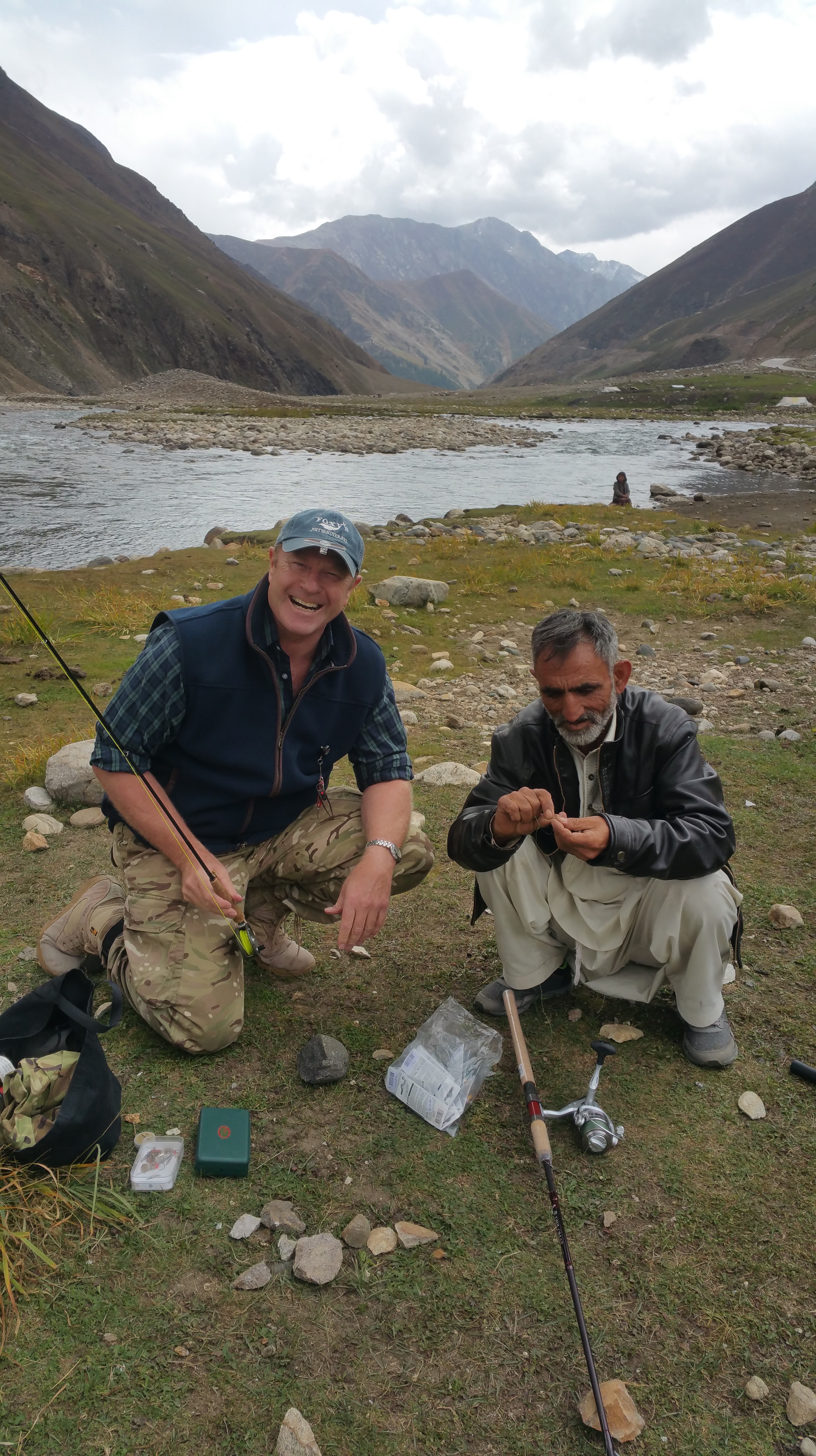
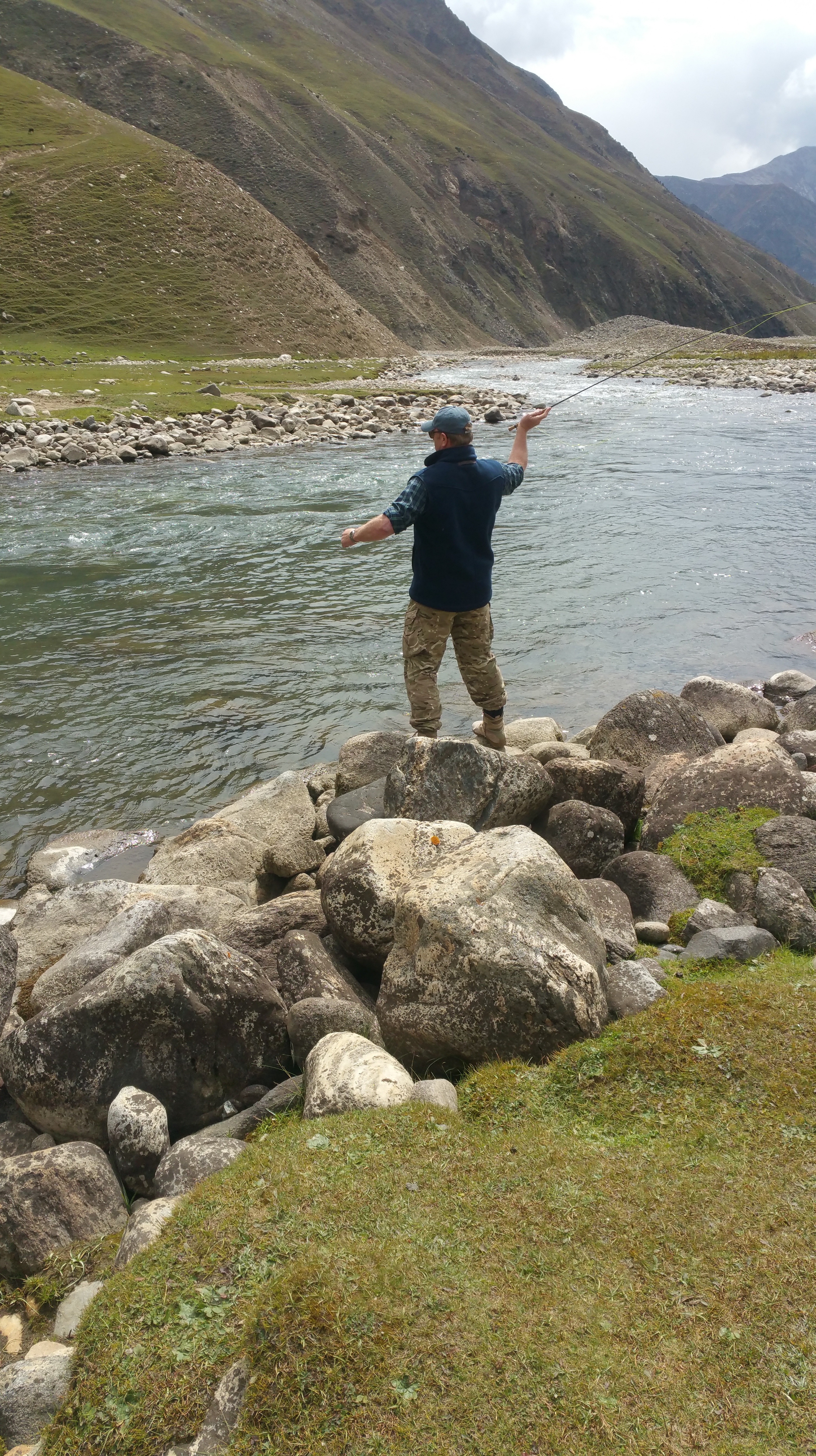
No excursion with Murray is complete without i) fishing (and/or ii) a trip to a casino, if at all possible). Naran provided the perfect opportunity to fish for trout (there are no casinos) in one of the most beautiful areas of the world.

IMG-20170915-WA0005

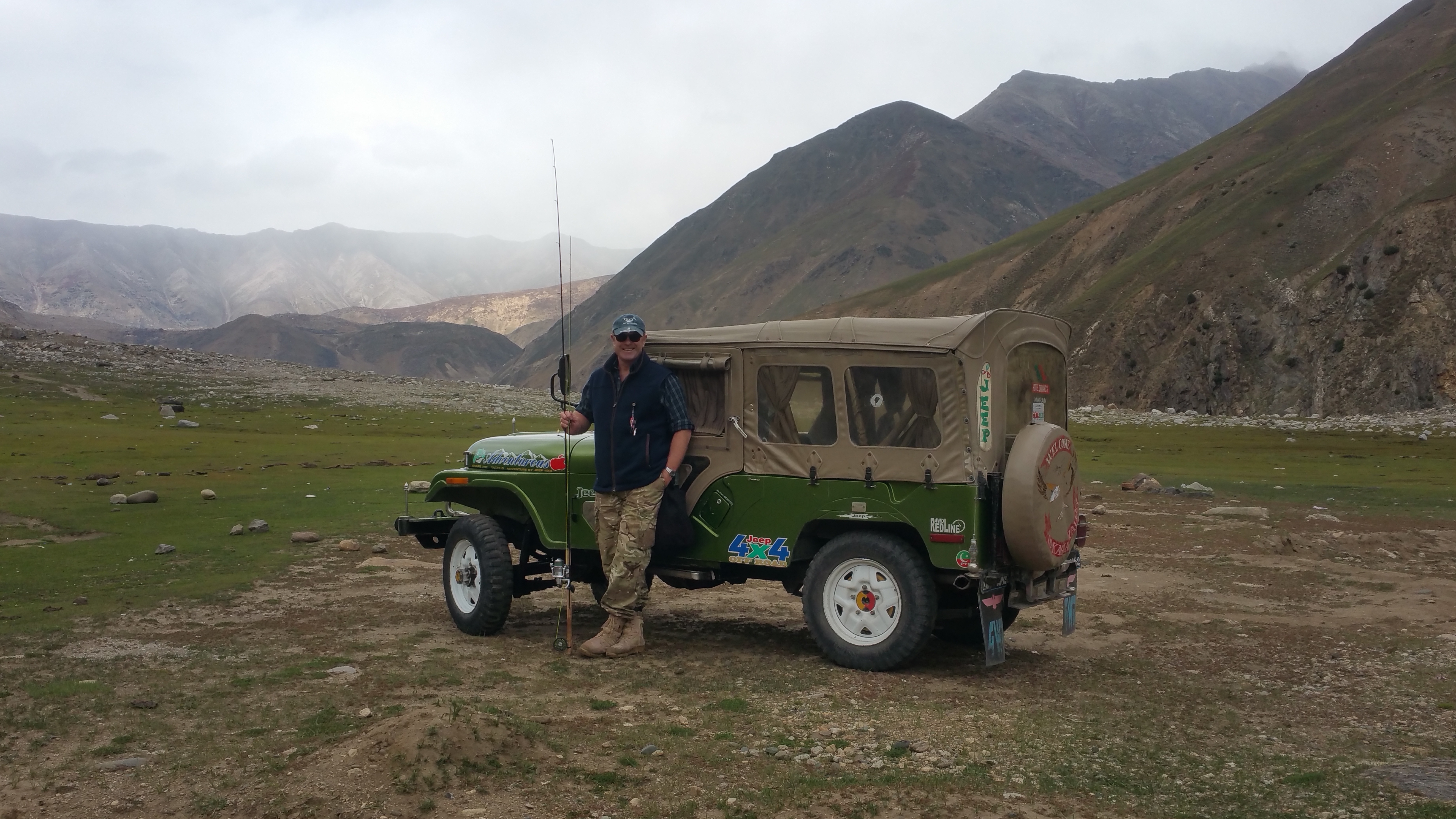
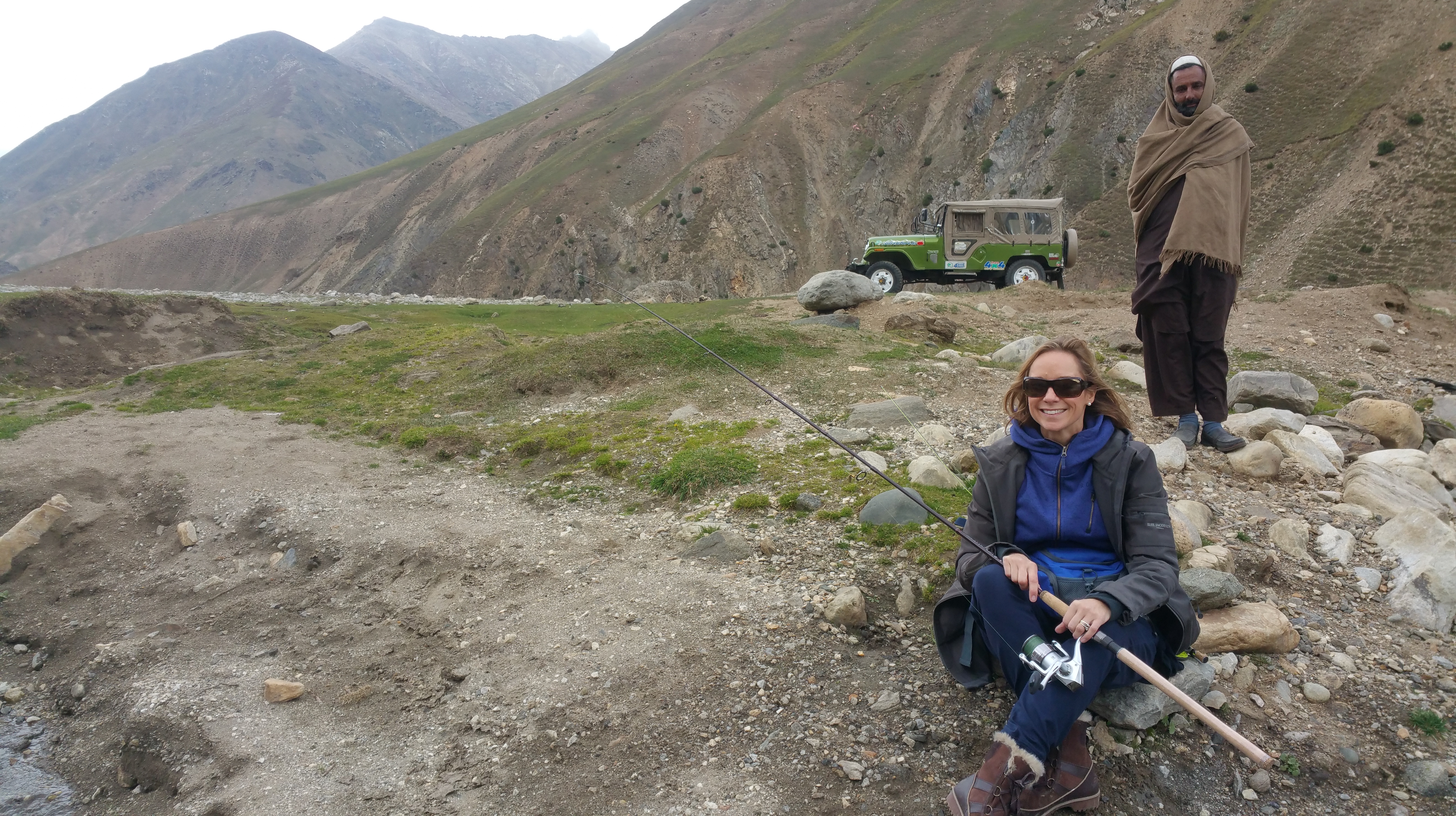
Having met our rogue of a guide the night before (his insistence of ‘one more bottle of beer’ through a toothless grin should have been warning enough!) and being presented with two beautiful fresh brown trout to be cooked for supper, we were very keen to get going and catch a fish or two. We were collected by the guide and his cousin, the driver of a 1976 jeep, after breakfast to be taken an hour up the valley to walk the river and fish with both fly and spinning rods. No time was spared and every corner cut, to get us to our destination.

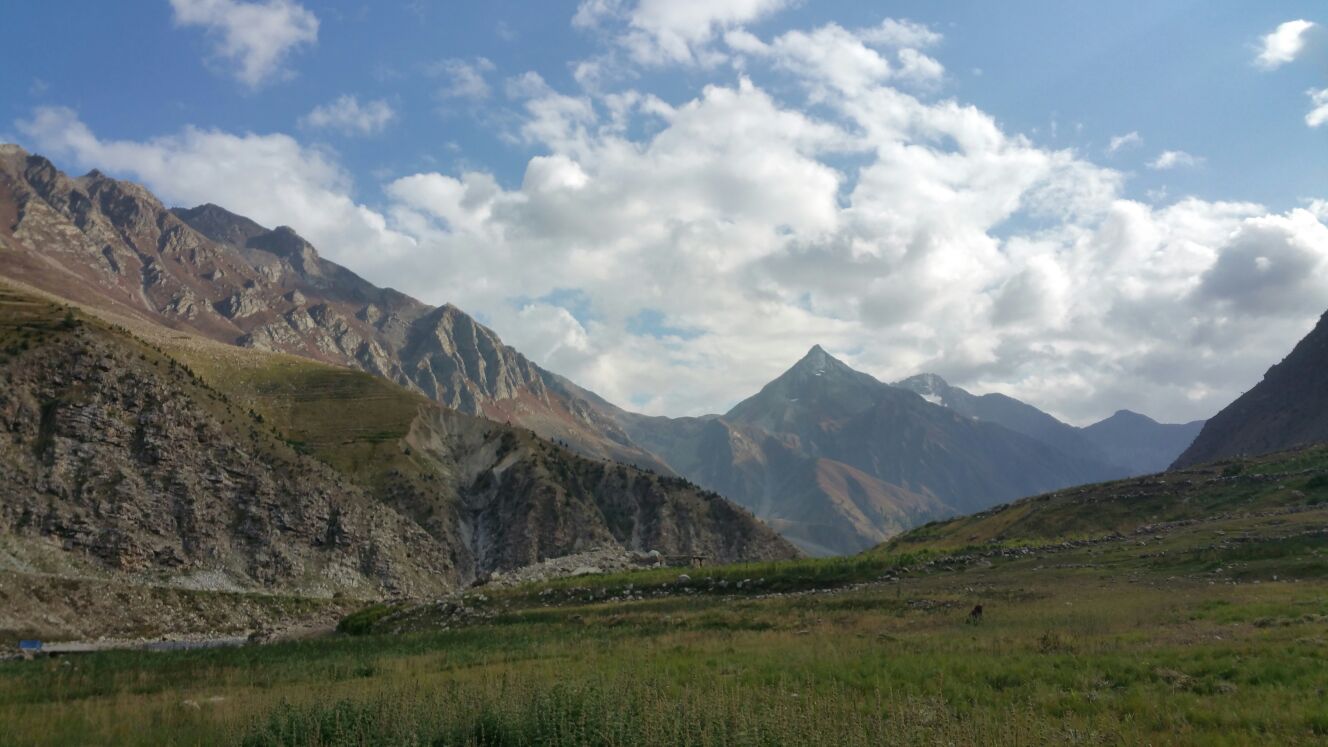
The day was spent walking and climbing the banks of the Kahgan River, passing camps of nomadic people in their last few weeks in the valley before moving to the low lands to avoid the heavy snowfalls. We really were in the depths of rural northern Khyber Pakhtunkhwa (KPK district). We were certainly the only white faces to be seen and caused much curiosity. On reflection I wonder whether this was because of our fishing endeavours rather than our appearance – not a sizable fish was to be found after 8 hours of hard fishing! The peoples of this area barely subsist on what they can grow so it is hardly surprising that they have netted the fish to near extinction. I suspect the trout our guide produced were from one of many fish farms in the area! It was chicken for supper that night – some of it rather oddly green in colour (best not to think about it too much).

14/09/17: Islamabad – Naran

Distance: 170 miles; Travelling time: 0615 – 1445; Temperature range: 32 – 13°C

IMG_20170808_203146_220

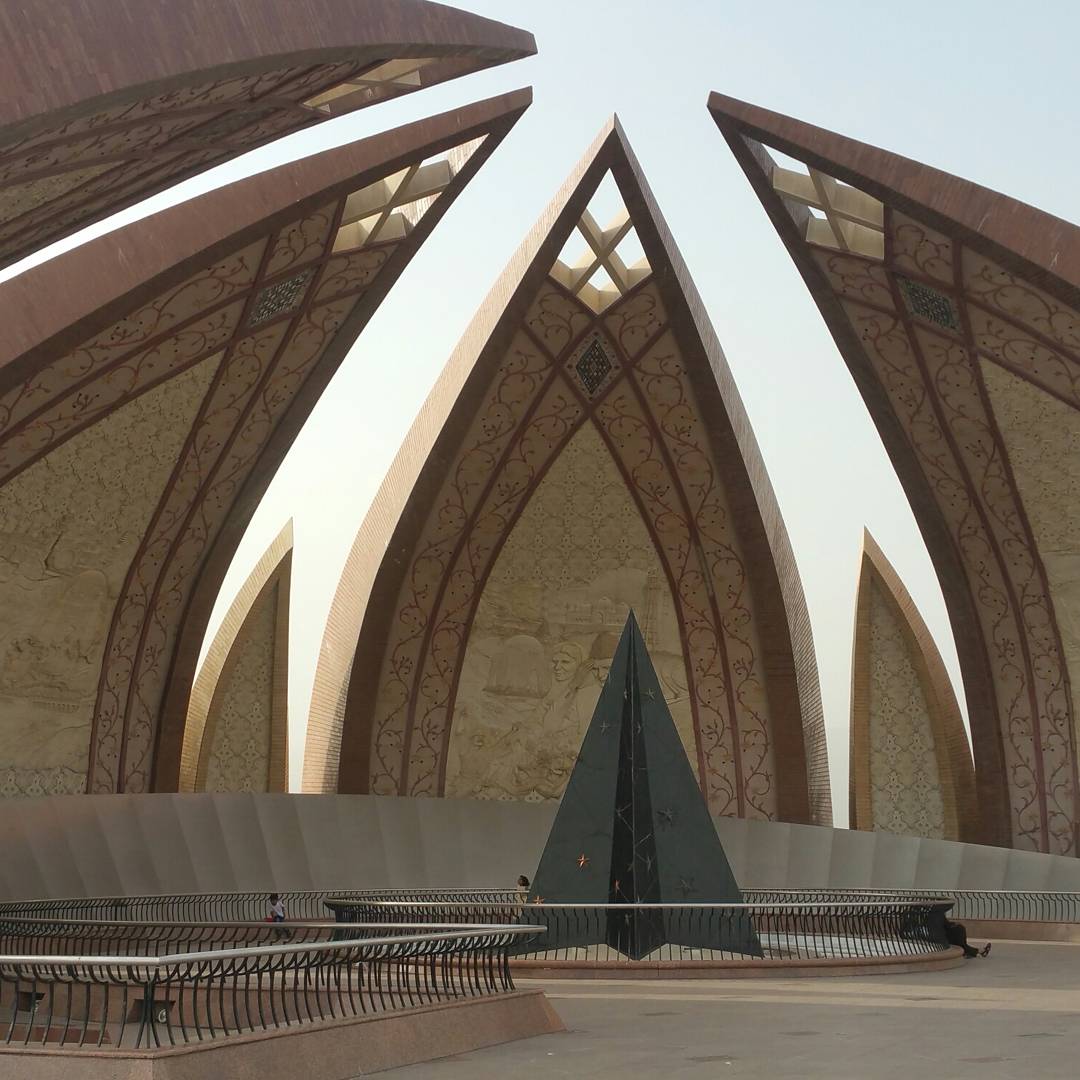
The Pakistan National Monument, Zero Point, Islamabad – our final visit before our departure 

The day has finally arrived to set off, wheels rolling, for home. With about 6,300 miles ahead of us we had the first challenge; to get everything we wanted in the car . .  and then to get the car started . . .

The car has been through a thorough makeover in the last weeks of August, replete with endless spares brought back from the UK and expertly fitted and overseen by Murray’s super driver, Zahid. Not only was the engine looking immaculate, as a treat and a surprise all the bodywork had been smoothed and sprayed to look like new! Pretty good for a 15 years old car – let’s hope it can stay the distance.

We set off at 0615 having found the car had been decorated by some stealthy neighbours (thank you, Giles and Lucy!), “Blighty or Bust” was emblazoned on the back of the car with trailing bottles to boot!


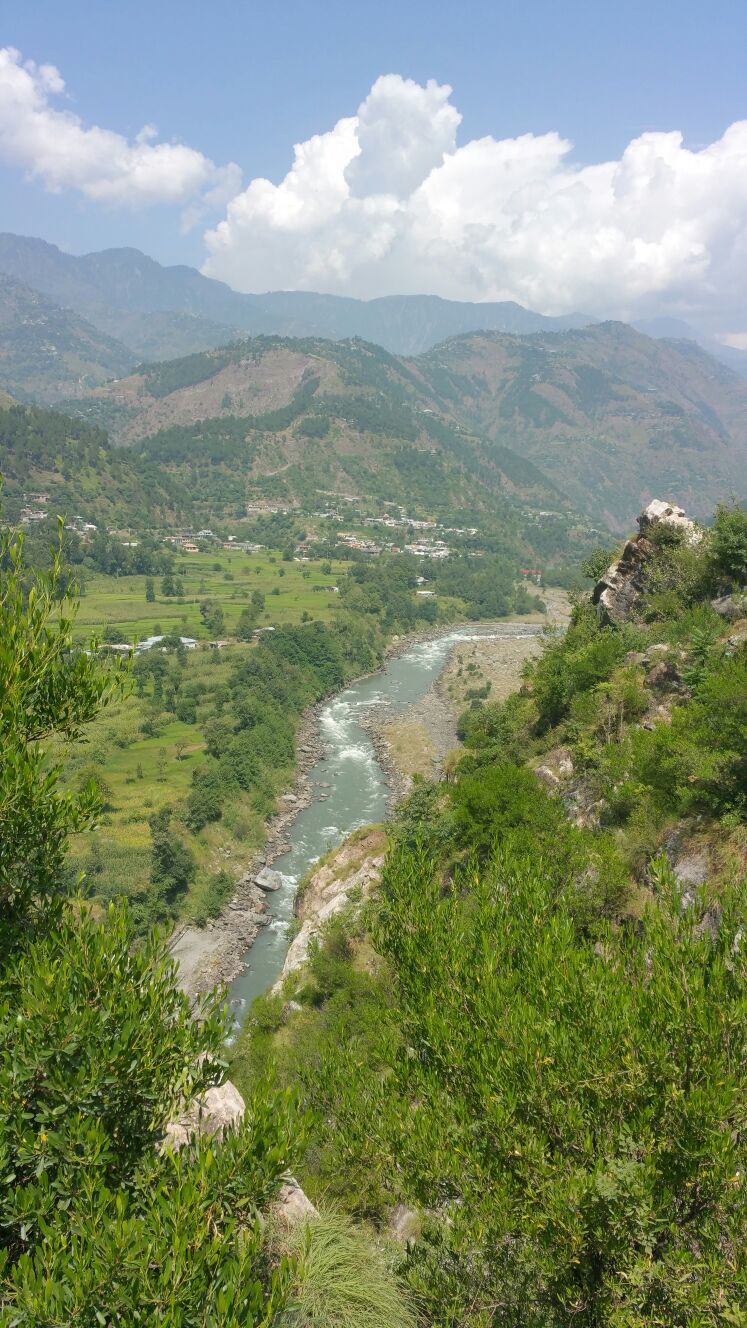
With everything packed in its place we set off for Murree on the Kashmir Highway, the sun rising and the promise of a beautiful day ahead, we had our metaphorical rose tinted “exit specs” on and everything looked stunning! We beat the morning rush and enjoyed the beautiful hills, the calm and the fresh air of Murree and Nathia Ghali to get through busy Abbottabad and on to the Karakorum Highway (KKH) arriving at Mansehra by midday and on to our first night in Naran.

IMG-20170914-WA0009

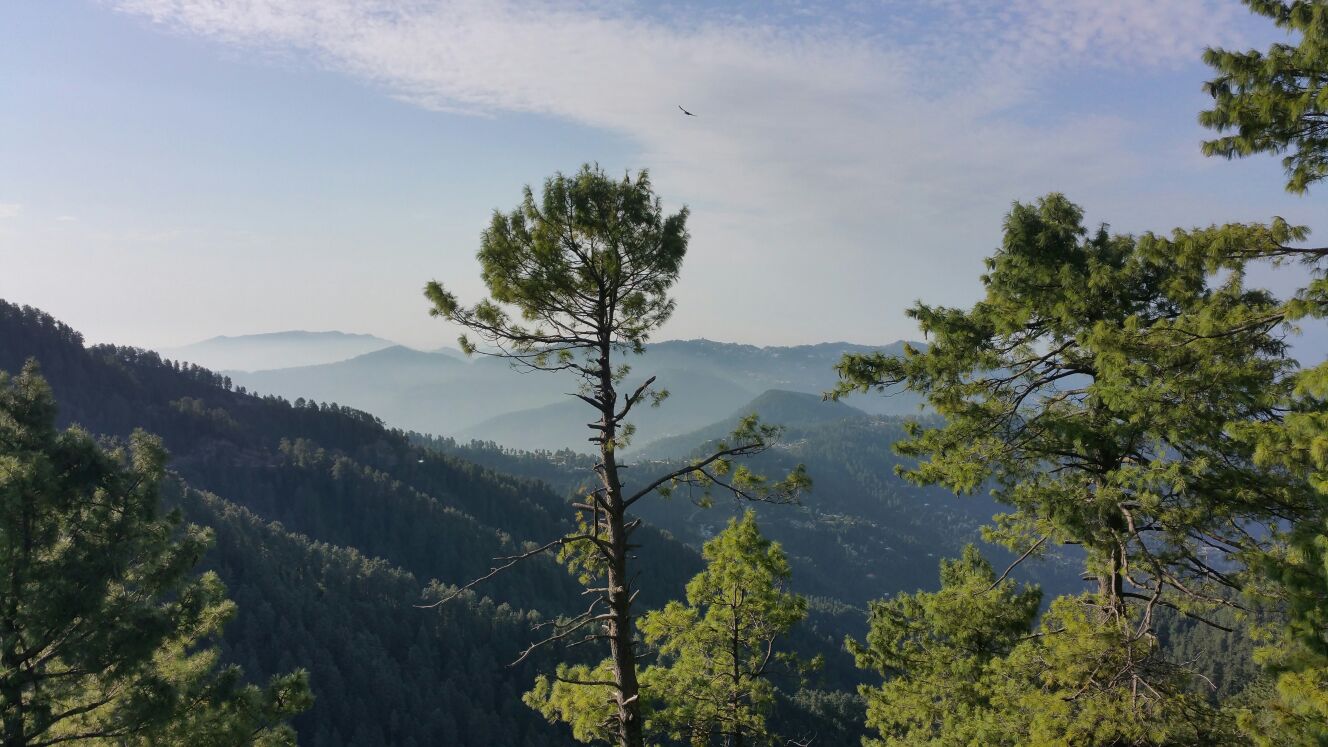
Views from Murree across to Kashmir

The KKH (N35) is the main, and only, road into China through the mountainous Northern Areas of Pakistan. Consequently it is busy and slow with heavy loads carried by the fabulously colourful jingle trucks, with some ancient Bedford trucks still in service. However, for a few clement months of the year a pass is open to non haulage traffic leading from Mensahra to Chilas via Naran (N15), going over the Babusar Pass. This is a stunningly beautiful road winding along the river through the Kaghan Valley and Little Himalayas and up to the highest point at Babusor at 13,690 ft (4,170m).
IMG-20170914-WA0010

Looking down on Balakot. This town was totally devastated by an earthquake in 2005 but has steadily been rebuilt and repopulated.

IMG-20170914-WA0005

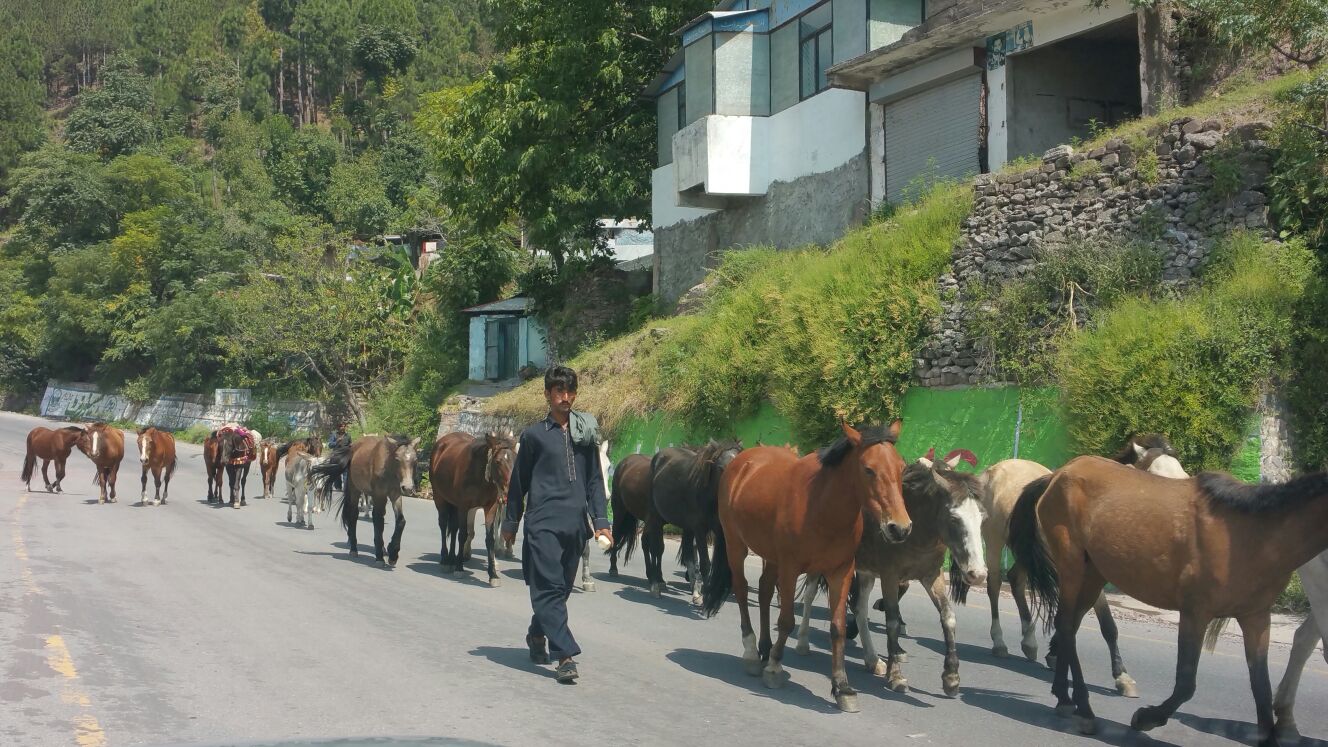
Herding horses along the main road.