06/10/17 Turkmenbashi

The sun rising and shining through a clear sky – good news for crossing the sea

I could write a book (I know this blog is already rather more long winded than intended!) on the experiences that we had over the next 36 hours but I think I would need therapy first to safely exorcise the memories of it all!

We spent the night in a surprisingly good hotel with great night staff (who tried their best to find out if the ferry would sail that night) – and a hotel lobby with a huge photographic portrait of the current president sporting a rather jaunty sailor’s hat, poised with binoculars a speedboat racing past in the background. It was rather surreal.

Having just about got over the loss of the ferry contact phone number, we had a restless night wondering if we’d get a call to move at short notice. Murray woke early in our ‘suite’ – the only room available when we arrived at midnight – and was mid downward dog (it’s a yoga position) when I woke and looked out of our top floor window, over the harbour, to see that the ferry had just set sail. Oh my God, what a sinking feeling. I momentarily faltered before asking him to take a look to confirm my fears. It was indeed the ship we had hoped to take. (We later found out that it was carrying hazardous cargo and we would not have been allowed to board it – phew!)

We were now resigned to try and get on the other ship that was in harbour, the newest ship in the ‘fleet’, the Bagtyyar. It was a beautiful day. We had found a contact at the port through the guide we had met at the Dervaza crater and agreed we would take the morning to recover and get ourselves prepared for processing the car export documents and secure a place on the ferry. Affirmative action!

What follows was long, testing, tedious and mind numbingly senseless but we were in motion, albeit slow, to leave Turkmenistan. Over the next 13 hours we waited variously in different offices, the grim passenger hall with an unspeakable excuse of a lavatory, watched the conscripts change shifts and don fantastic mauve fur-trimmed winter combat jackets with belted waists (Topshop should take note!), and cooked up our Army rations – thank you Jules, they have been a life saver. We had one ‘friendly’ conscript who spoke good English and while obviously piqued by our repeated asking of what happens now and how much longer will this take, was never the less as helpful as he could be. The bottom line was that no one really knew how long any of this would take.

While hanging around the guarded and secluded customs and immigration offices, having eventually forced the customs people to process our papers at 6pm by waving our diplomatic papers, we had been told that we could either load first ahead of all the lorries, or last. If we loaded last we would be first off at Baku, so we opted to wait, slightly nervously, just in case they couldn’t fit us on after loading the 63 lorries.

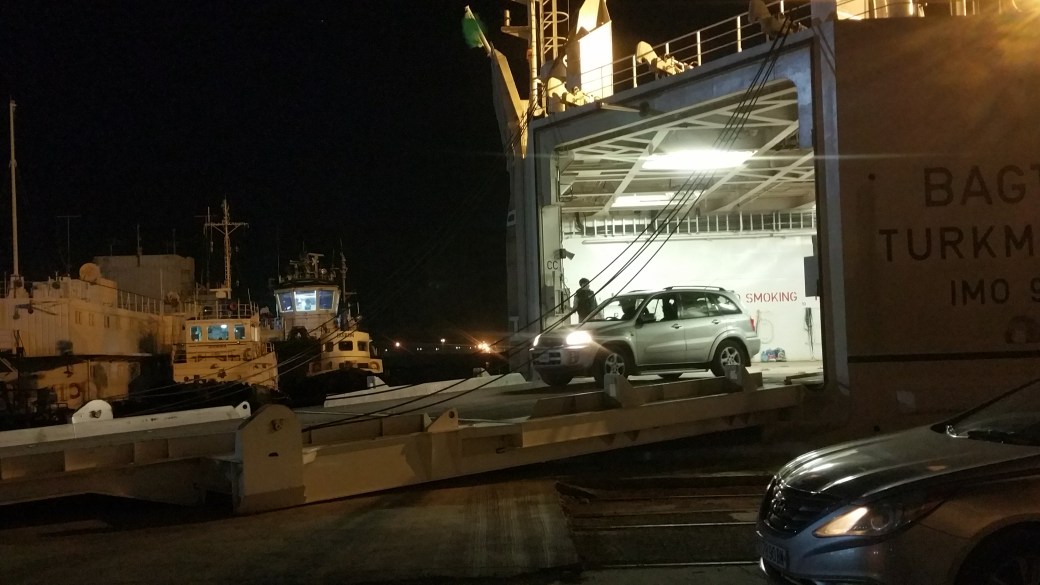
All 63 lorries – most them vast juggernauts – had to reverse on to the ship up a ramp at an oblique angle to the dock. It took 5 hours for them to load. We eventually loaded our car at 22:45 but we still had to be processed through immigration, along with 63 lorry drivers and another 20 foot passengers. To do this we had to walk 2.5 km, in the dark through lorry and trailer compounds, over the train tracks, back to the immigration office before pushing our way into the immigration area – queuing isn’t a recognised action in this part of the world! It took another couple of hours, a lot of hanging around in the dark and chilled night air before fighting to get on a bus to take us back to the ferry. It was tantamount to being herded like cattle, or refugees. What was extraordinary is that everyone else just excepted it as the way it is. There was no concurrent activity by the authorities, people were processed one by one and we were all held before the next step, even though all the officials were in place to carry out the subsequent steps. Just inexplicable. It was less disorganised and seemed more of a means of controlling people – any sign of complaint or dissent and I sense it would have been met with arrest.
20171006_223828

Last on . . . first off? We could but hope.

Once on the ferry a bun fight ensued to get a cabin. By 01:00 we were in our cosy, clean double birthed cabin – M was a little surprised it didn’t have a double bed until I reminded him that the majority of passengers were hardened lone lorry drivers and this wasn’t the QEII!

Absolutely shattered we were comatose for about 20 minutes before the loud speaker announcements started and we were roused to get any belongings from the car that were needed for the duration of the crossing.

We were not due to set sail until 08:00 the following morning so having finally got to sleep at 02:30 we hoped for a bit of lie in with a 12 hour crossing ahead of us.
05/10/17: Ashgabat – Turkmenbashi

Travelling time: 09:45 – 17:40 – Distance: 373 miles – 10°C and windy – cumulative milage: 3134

fullsizeoutput_e1a.jpeg

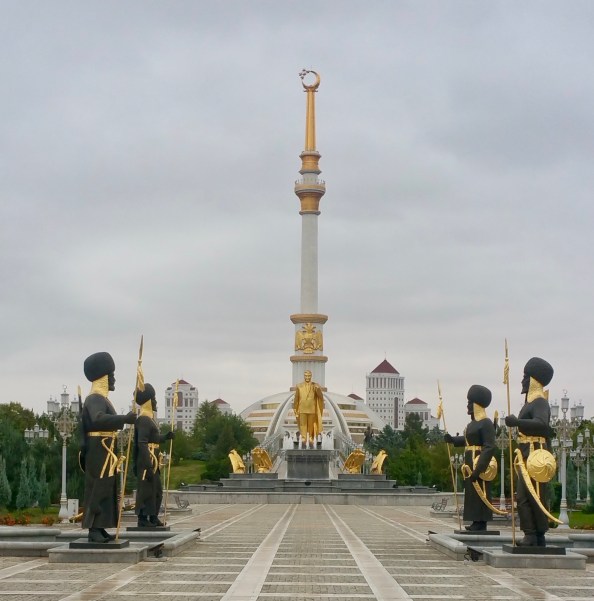
One of the many monuments to the former president of Turkmenistan, Niyazov, in his golden cape 

Heading west at last to the Caspian sea port of Turkmenbashi, we set off with laundered clothes and the prospect of great roads – happy days!

Before leaving the surreal marble clad wonder that is Ashgabat we went in search of the elusive US dollar as we needed these to pay for the ferry crossing. (As a foreigner one is not entitled to pay in local currency.) We failed on this mission but agreed we really ought to be able to find some once we got to Turkmenbashi. We took one last drive through the city to try and absorb the sense of it – it was immaculate, manicured and devoid of shops with very few people other than those cleaning or gardening – but the presence of policemen at regular and frequent intervals made up for the lack of city dwellers.

We followed signs to Turkmenbashy for as long as they lasted (to have any signs at all was remarkable in itself) and then resorted to the map which took us past a small airport, much to the driver’s excitement as it looked to be a military base with Hind helicopter gunships whizzing about. I really did have to put my foot down at this point when repeatedly asked if I would take a photo of the incoming helicopters, purely for professional interest, right in front of a police check point; clearly a bad idea from every aspect, in my opinion. The memory of the mind’s eye would have to suffice.

Our journey to Turkmenbashi was swift and comfortable and we took turns in driving – it was great not to cause curiosity as a female driver, unlike Uzbekistan where I think I might have caused whiplash in certain instances – I hasten to add through looking, not crashing!

We passed Gök Depe (written Geok Tepe in the history books – all part of the Great Game) – the site of a terrible battle between the Turkmen and the Russians in 1880. 6,000 Russian troops defeated 25,000 Turkmen in a siege lasting 23 days with the Russians finally tunnelling under the fortified walls of the town and blowing it to smithereens.

The route follows the Köpetdag Mountains, bordering Iran, before levelling out into the Köpetdag basin. At this point we thought we were about to hit a log jam on the highway, multiple cars ahead were bunched up across the road with hazard lights going, five across and goodness knows how many deep. As we got closer we saw that it was a wedding procession! It looked like the bride was in the centre car, which had a crown-like floral arrangement on the roof, and all the other cars took it in turns to shroud and protect her. Quite terrifying at speed. We managed to get past by squeezing through between the outer cars and the central crash barrier and carried on.

We arrived in Turkmenbashi at 17:40 and made our way to the port after some considerable dithering as there are no signs and there was an enormous amount of construction being carried out both on the roads and the the surrounding infrastructure. By chance we met a guy who worked on one of the ferries – he helped enormously showing us where to go. It was a start.

One of the potential sticking points of our whole adventure was the Caspian sea crossing – we were not allowed into Iran, nor Russia, so the way westward for us was via the sea.  The only way for us to cross with the car was to seek passage on a cargo ferry, either from Turkmenistan or Kazakhstan. I had been very concerned about this from the get go of this madcap plan as there is no guarantee of getting aboard nor do the ferries run to a schedule. They simply sail when they are full and then there is the possibility of staying at anchor just outside the port for an indefinite time. People spend days waiting for passage. For foreigners there is the added concern that transit visas are finite, often just three days in total. We had ten days on our visa, with four already used we had less concern on that front.

Murray had tried to quell my concerns by tracking all the ferries that cross from Azerbaijan to Turkmenistan on http://www.marinetraffic.com over the past 6 weeks and creating a spreadsheet to see if there was any pattern to the crossings. He had his mind set on one particular ship working for us, the Bagtyyar, as it was the most reliable and crossed regularly. It just so happened to be in port when we arrived but it was not sailing for two more days. However, there was one other ship that we established was sailing that night. With every hope that we had got lucky we hung around in the grim port waiting area to see if we could get on it. This was the beginning of our trials to make sense of the process and procedure to board a Caspian ferry, it was akin to entering a black hole.

Three or so hours later and with no information forthcoming, other than being told by various young army conscripts to ‘just wait’ (more on those later), we decided to sack it for the night and find a hotel. We were pretty tired and cold and no further forward in trying to work out how to get on the ferry. But we had the mobile number of the ferry worker who had helped us earlier, so in theory we could call to find out if the ship would sail that night, only I had misplaced the piece of paper it was written on ( – eek!).

[Note to others trying this escapade – having entered the port, one needs to buy a ticket to get out of the port. This we only established having driven the kilometre to the barrier and then back again, twice, having had the phrase for purchasing the required ticket written on the said piece of paper. It was a not what we needed after a long day.]


04/10/17: Dervaza – Ashgabat

Travelling time: 09:45 – 13:40 – Distance: 170 miles

IMG_2180

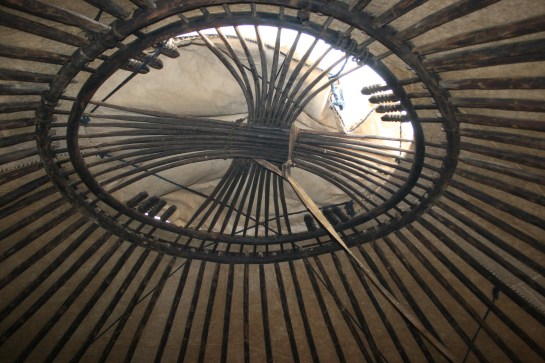
Looking up to the tunduk, the circular sky light cum vent in the centre of the yurt’s roof. It’s shape is depicted on the Kyrgyzstan flag

We had repaired a little merry after a jovial evening to our respective bed spaces the night before; Natalie and her guide to their tents, their driver to his car and us to the yurt. The shepherd had sensibly taken himself off home to his winter abode, to return shortly after first light. It had been a bitterly cold night in the yurt although we had more than enough sleeping bags and blankets to keep us warm.

Waking at 4 am with the cold and not wanting to move lest it make one any colder, it was time to reluctantly pop out for a pee. I am so glad I did. The night sky was magnificent. The stars shone brilliantly, the glow from the crater fires gave off an unearthly glow and the sand dunes were silhouetted by a near full moon. It was a magical scene and well worth the detour from Burkhara to the northern boarder.

The start of a new day . . a little creaky and not a little cold!

On the road to Ashgabat – fortunately we weren’t going at breakneck speed (unlike the majority of local drivers) when we came across this little train of camels noisily slurping and draining some rare rainwater. 

After a tasty and long breakfast, prepared by the very hospitable shepherd, with our new friends we shared our plans (and coffee) and more travel advice and set off for the capital of Turkmenistan, Ashgabat. We had heard much of this relatively newly built city, clad with imported Italian marble and marked with golden monuments of Turkmenbashi, ‘Leader of the Turkmen’, the now deceased former president, Niyazov.

Ashgabat had been completely destroyed in 1948 by a massive earthquake killing two thirds of the country’s population, the extent of which was kept from the world during the Soviet period but it has since become recognised as and a national day of mourning on its anniversary on the 6th October. After independence in 1991 the old Soviet built city was razed and in its place gleaming white buildings, immaculately manicured parkland and striking monuments form the inner city.

It is forbidden to drive a dirty car in the city and so we dutifully stopped at a fortified cleaning station teaming with what we found to be men offering a taxi service into the city – it was a mistake to enter this compound with our windows down and quite remarkable how many heads can fit inside an open car window. The aroma this in itself manifested was almost knock out! It was the beginning of a bizarre experience.

With car now gleaming and rid of all signs of the desert and anything else that might have clung to the wheel arches on our trip thus far we timidly entered the city cautious of the many roadside police waving their striped batons and rigidly sticking to the varying speed limits – now recognisable to us from a distance by their silhouette of an enormous Russian style hat! Rows and rows of sterile white houses lead on to rows and towers of palatial city buildings. Had the day been sunny it would have been awe inspiringly dazzling but in the gloom of a grey sky it was slightly unnerving. While there were cars on the road there were so few people to be seen or signs of habitation in any of these monoliths.

We drove on, aware that photographing buildings not advisable as no government building should be photographed, nor certain monuments and since we were not sure what was what we (I) thought it best to stick to the advice we had been given.

We made our way to the hotel, the Ak Altyn, again, kindly arranged for us by the British Embassy, this time in Ashgabat and incidentally situated next door to our hotel. We unloaded, de-gunged from our desert excursion and made our way to say hello to the UK deputy Head of Mission and his assistant. It was great to be with a fellow Brit, albeit briefly. We then headed out to take in the city and find somewhere to eat. The city was a welcomed respite from the tourist towns and rural areas. A great restaurant was recommended to us, Köpetdag, named after the mountains beyond Ashgabat and bordering Iran. It’s a funky restaurant with a diverse international menu and very well run and popular with the well heeled city dwellers.

03/10/17: Dashogus – Dervaza

Travelling time: 13:00 – 17:50 – Temperature: 3 – 15°C

20171003_210120

While being able to pay for the border fees in US Dollars (all 9 of them – we were expecting to pay a great deal more) we really needed to get hold of some Turkmen Manat so that we could buy much needed diesel having used up two of our precious jerry can supplies on the way from Samarkand to the border. Murray’s calculations had been absolutely spot on but we needed to refuel before heading into the depths of the Karakum desert.

We consulted the much loved Maps.me app and I found a number of banks in the heart of Dashogus which should have taken a VISA card and throw out the local currency. By the time we had entered the town it became obvious very quickly that there is an overwhelming police presence all out to ‘get ya’! Random car checks occur at intersections, traffic lights and periodically from behind trees for no apparent reason. Getting cash was not to be so straightforward but we met two men at an ATM who after a couple of phone calls told us that we needed to head to the local airport where there would be an obliging ATM. These men were very kind, helpful and self-deprecating of their lack of English – we were beyond grateful and charmed by their kindness.

So, with less of a wad than our previous currency exchange we filled up at a very smart filling station, helped by another friendly Turkman who covertly filled our jerry cans while still in the boot behind my bag of Ikat fabric and some newly acquired water colour paintings of the silk route – really! Thankfully a good job was done and no diesel was spilt.

Now we were on the open road to our next destination, Dervaza and the Devil’s Crater – or the Door to Hell. We had about 220 miles to cover, half of this on great roads, the rest on terrible pitted tarmac. The flaming crater of Dervaza has become a national attraction although in reality it is a rather a damning indictment on the state of this nation, both in Soviet times and since independence. The crater appeared in the early 1970’s under tragic circumstances when a Russian drilling rig, prospecting for oil, literally fell foul and collapsed into a 70 meter sink hole, killing the rig crew and exposing a natural gas source. With the gas source leaking into the air it was thought that by setting it alight it would burn out. Some 45 years later it is still burning.

Deep in the Karakum desert and in the heart of the country, we had made arrangements through our contact in Tashkent to stay in the yurt of a local shepherd close to the Devil’s Crator. We arrived at the point on the ‘highway’ where we estimated the track off the road to the crater lay (just past a desolate railway crossing and a penal posting of police checkpoint. There was no one to be seen and the sun was beginning to set. After a long day this was a little anxious making as were about 180 miles from anywhere in either direction and we had no desire to travel on after dark. The desert winds must have whispered as about 10 minutes later our Russian speaking shepherd arrived in his 4 x 4 and we were able to followed him into the desert on what had become a reasonably defined track at this time of year. There we found a traditional yurt and lovely barbecue supper being prepared for us. What a fantastic moment!
20171003_184610

The panorama at sunset

We drove on to the burning crater some 400 meters from the yurt and watched the sun go down, accompanied by the eerie roar of the burning gas and the jumping plumes of flames licking the edges of the crater.

We were not totally alone. On the near horizon we saw a slightly odd sight of a pick-up truck with what looked like a large box affixed to the flat bed. It was in fact the transport and living arrangements for a wonderfully eccentric French couple whom had travelled from France, through Scandinavia and Russia to Central Asia in their self modified truck. Good on them!

As the sun had gone down the temperature dropped dramatically. We returned to the yurt and found a delicious supper and two delightful companions. A charming young British girl and her equally charming Turkmen guide were joining us for supper. It turned out that Natalie, from Wild Frontiers Travel was scoping the region for tailor made excursion for her more adventurous clients. Her guide was a one time Soviet war veteran with an amazing command of English and knowledge of literature and history from both the East and West. It made for a very entertaining evening of shared war stories between the Lieutenant and the Brigadier General, imparting of historical details of the region and great advice. We almost forgot to see the crater at its most beguiling, after dark.

03/10/17: Khiva – Dashoguz, Turkmenistan

Travelling time: 09:45 – 12:55

20171003_123331

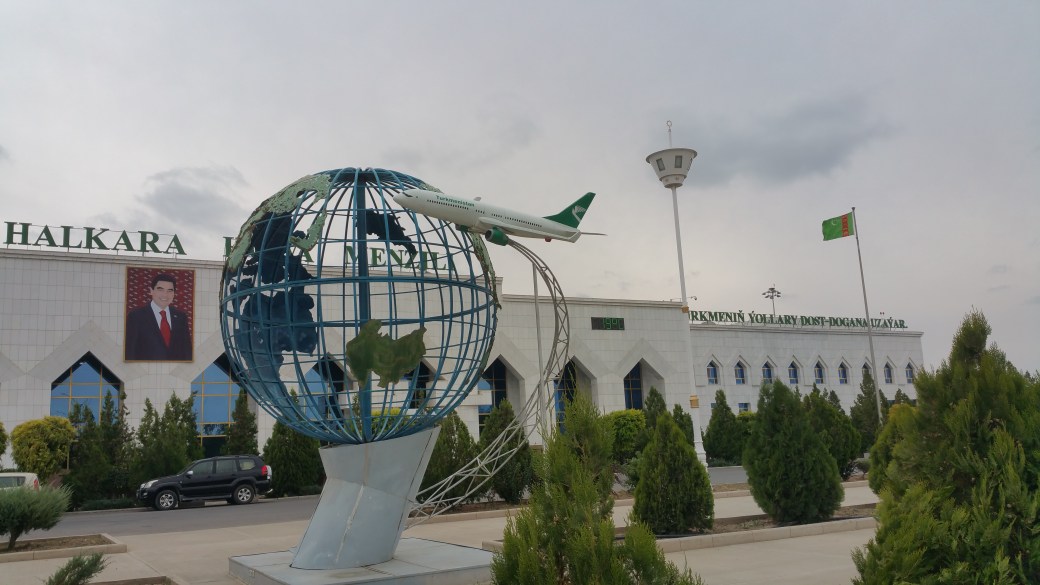
Dashogus Airport, one of many white marbled and gilded State buildings, flying the Turkmenistan flag and showing the President’s ubiquitous portrait.

The day ahead held a pretty big ask. Not only did we have reasonable stretch of road to cover, with unknown road conditions, we had what we anticipated to be the toughest of borders to cross, that of Turkmenistan. With all our research, reading of guidebooks, scouring blogs and travel websites of far flung places and conversations sought with fellow travellers and consulates, we expected this to be a long day.

We took advice from our host as to the best road to take to the border, that deemed to be through the tiny village of Shovot (Uzbekistan) and into Dashoguz in the north of Turkmensitan. This is a small and less frequently used crossing, compared to the busy border between Nukus and Konye-Urgench which draws tourists to the ancient city of Urgench, once the centre of the Muslim world and seat of the Khorezm empire in the 12th Century, a major trading post and city of learning. It was the scene of bloody Mongol battles with the arrival of Genghis Khan seeking revenge and the further spread of power and latterly decimated by Temur.

The road to the border post was unsurprisingly poor but Murray now had navigating the potholes in hand and we covered the 36 miles in just over an hour. We were one of the first to get to the crossing and made it out of Uzbekistan will relative ease, although it took a little time to persuade the senior immigration officer that we were simply visiting Uzbekistan as tourists and not on official business.

We were into Turkmenistan! Driving the 1 km between the posts our passports were checked by no less than three impossibly young Turkmen, clad in the uniform of conscripts, each of whom spoke a significant amount of English and welcomed us warmly. We were feeling quietly confident – none of the brusqueness of a police run state had yet been demonstrated. The official building at this small post was pleasingly orderly and filled with all flavours of officials, some in uniform, others not. We had our first glimpse of the pretty Turkmen national symbol and the first portrait of the President, with many more to come.

The process here was a little more exacting than crossing into Uzbekistan but having gone from one desk to another, with our official letter of invitation (which took three months to obtain before we left Islamabad!) as our licence to enter we were issued with a rare 10 day transit visa, and no mention of the usual compulsory guide for visits of longer that 3 days was mentioned.

On to customs to get the car into the country. This took a little longer and was somewhat more convoluted with no less than 5 stamps required from different officials. The result was a very smart green and white document, with the imposing green Turkmen star, and a definitive, no variation or deviation marked of our transit route through the country. So, here began the control, after a straight forward 2 hours of process and procedure.

02/10/17: Burkhara – Khiva


Longest days drive: 284 miles – Travel time: 07:00 – 13:40

20171002_162306

Leaving Burkhara shortly after first light our spirits sank as the road surface quickly developed into a dismal, diabolical sequence of craters, dust and deep, striated cracks. It was tough to navigate and maintain any speed. We began to question the sense of travelling north having covered 30 miles in the first hour, knowing it was a further 250 miles to reach Khiva. At that rate it was going to take 8 hours to get to the walled city and we wouldn’t make it until after dark. Notwithstanding the recommendation to see the city by moonlight, it didn’t do much for our humour.

All said we were committed to this route and pressed on. Thank God (and possibly the Chinese) the road changed dramatically at Gazli (which appeared to be a gas or oil related settlement) and we hit a super smooth, brand new two-lane highway! Spirits soared and we travelled on the best road since leaving Islamabad, clocking a steady 80 miles an hour for a good two hours.

With no one else around we could pit stop quite happily on the hard shoulder – or indeed in the middle of the road!

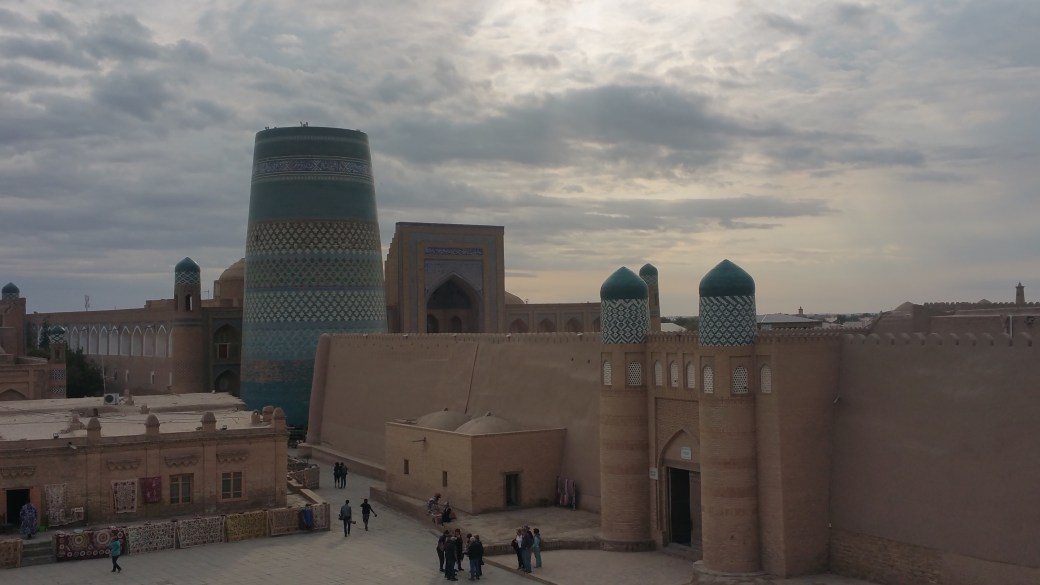
The highway ended and we travelled another 30km on relatively reasonable roads to get to the provincial city of Urgench and then 25 km further on to Khiva. After 5 and half hours of travelling we were slightly challenged to find the accommodation that had been booked for us. It transpired that it was situated slap bang in the middle of the ancient walled city in the Ichon Qala, and cars were not permitted, nor physically able, to enter. Murray disappeared for 20 minutes or so leaving me parked up in the middle of a bustling, frenetic bazaar, with the impatient minivan taxis reversing and hooting, picking up shoppers and school children all keen to be in the same place at the same time. He returned with the smiliest of fellows, a young English teacher cum hotelier who had room in his ‘inn’ – I wanted to think of it as a caravanserai, but this proved too romantic a notion. Unhooking the net that stretches across the back seat of the car (holding innumerable odds and ends for our travels) and piling up what I could to one side I squeezed myself on top of my bag of clothes and lay partially folded across the back so that our hotelier – who’s head peaked through the sun roof he was so tall! – directed us to his accommodation, the Islambek Hotel.

There we met a young and enthusiastic Swizz couple whom had bought a clapped out Land Cruiser in Tajikistan and were driving it home, having made some significant adjustments under the bonnet! We settled in to our very modest accommodation and left the car securely parked before heading off to see Khiva and all it promised to offer.

More mosques, minarets, majolica tiles and souvenirs (over indulgence of mosque and majolica, a malaise was beginning to take ahold!) . . . Ashgabat is calling but I fear we will be visiting Hell first . . .


01/10/17: Bukhara – “The mission is the drive. Anything else is a bonus”!

Cumulative distance travelled to date: 2,048 miles – Temperature: 16 – 18°C

fullsizeoutput_e17

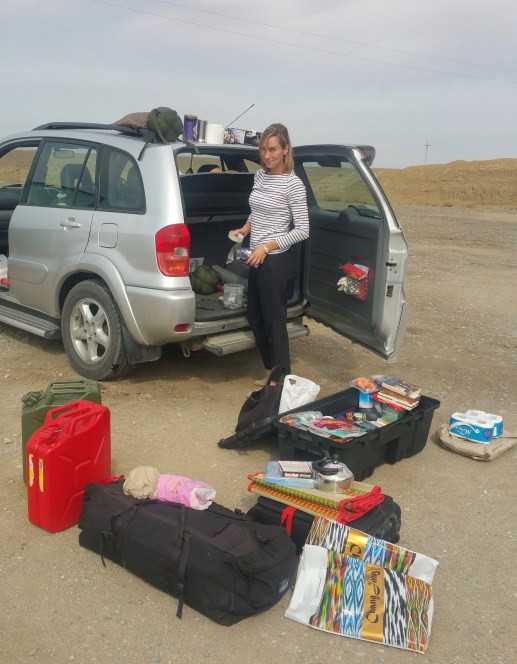
Prepping for the onward drive; jerry cans deployed, souvenirs ready to stow and ‘essentials’ brought forward (Fortnum’s coffee and loo rolls!!)

So, we were to have our bonus day in Burkhara. What a relief it was as we were both feeling a little jaded from the travelling. It had the feel of an Egyptian resort (sort of) but without the sea (obviously). We spent the day mooching through the streets and preparing for the next few days drive. It was during this time that I was duly reminded by Murray that while we were not working this was not a holiday but an adventure:

“The mission is the drive. Anything else is a bonus”

IMG_2080-min

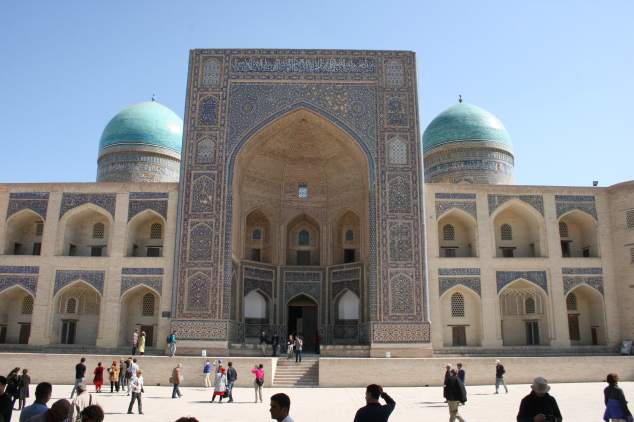
The Mir-i-Arab madrassa – another majolica tiled wonder


The mighty Ark – the seat of the Bukhara khanate and a fortress notoriously occupied by the megalomaniac Emir Nasrullah Khan in the 1800s. From here the Emir sealed the fate of the two British officers Stoddart and Connolly, players in the Great Game. They came to their end here, the first having been imprisoned after offending the Emir on arrival by not dismounting from his horse, the second who failed to secure a communique from Queen Victoria to explain that he was not spying for rival khanates of Kokand and Khiva. They were tossed in the vile bug-pit in the local jail for many months before being beheaded in the courtyard with the Ark.

In 1920 the Ark was bombed by the Red Army devastating much of it. Since then the majority of the outer walls have been renovated but 80% within remains in ruins. The areas that were not damaged now form a collection of museums and a back drop for the local artisans to sell their wares.

After some discussion and consultation of maps and more fuel calculations the plan was set to drive to Khiva and then to cross into Turkmenistan in the north and finally head south, via the Derweze fire crater – the gate to Hell – deep in the Karakum desert, to Ashgabat.

Over supper in Palov, the plov restaurant and into our second bottle of Uzbek dry red ‘Bagizagan’ (try saying that after one glass, three glasses promotes fits of giggles) we found out the name of the Kyrgyz warrior on horseback outside Jalalabat – and no, Nick, it wasn’t our old mate Genghis (nice try!), it was in fact the ‘Hero Kurmanbek’ Having Googled furiously on the very slow wifi while waiting for our order we were no closer to knowing exactly who he was but could surmise he wasn’t the recently dishonoured former Kyrgyz president (to the amusement of the waiter who suggested he be their Kyrgyz ‘Temur’), now in exile in Russia after some terrible misdemeanour.

We had absolutely no idea what was going on here but it was colourful and rather fun and seemed to be the Uzbek version of the ‘Sealed Knot’ – lots of amateurs dressed up in traditional garb posturing – or perhaps it was another ‘wedding’? (Jamie – we saw that bride again! She really gets around)

The end of the day . . . 


30/09/17: Samarkand – Bukhara

Travelling time: 09:30 – 13:20 – Distance: 173 miles

20170930_163822

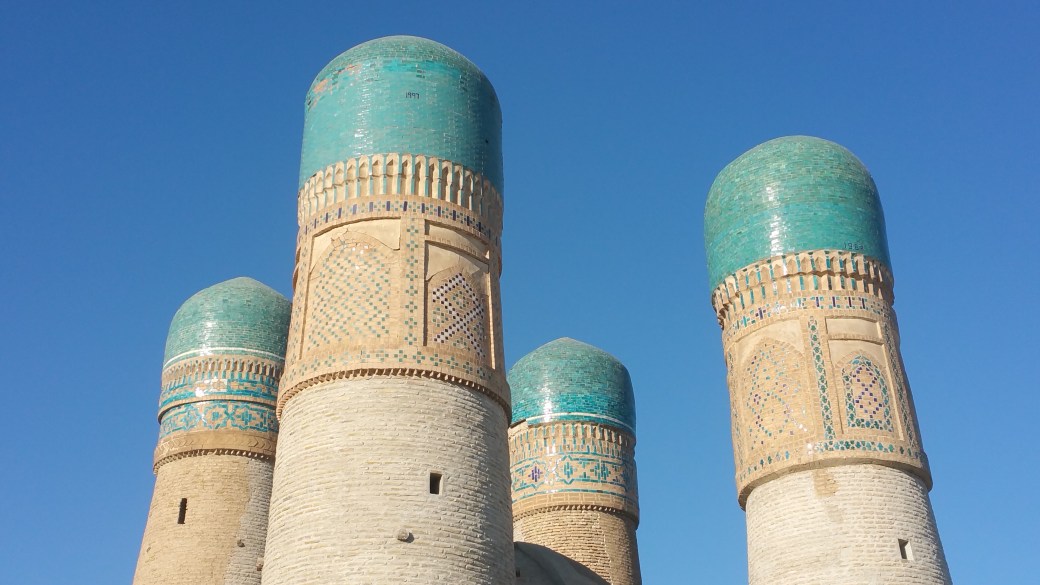
The Chor Minor – built in 1807 as a beautiful little gatehouse to a now defunct mosque.

We anticipated a drive of about 3-4 hours to get from Samarkand to Burkhara. Our questioning of the various members of hotel staff indicated that the journey could take anywhere between 3 and 6 hours. (For anyone wishing to drive this road, take note; the road around Ishtixon is the worst we have had to date, although at this time work is being done to improve it. Don’t be disheartened, it does improve eventually.) We shook rattled and rolled our way to Burkhara – not the most enjoyable of journeys at times. The poor old car took a bit of a beating.

20170930_173441

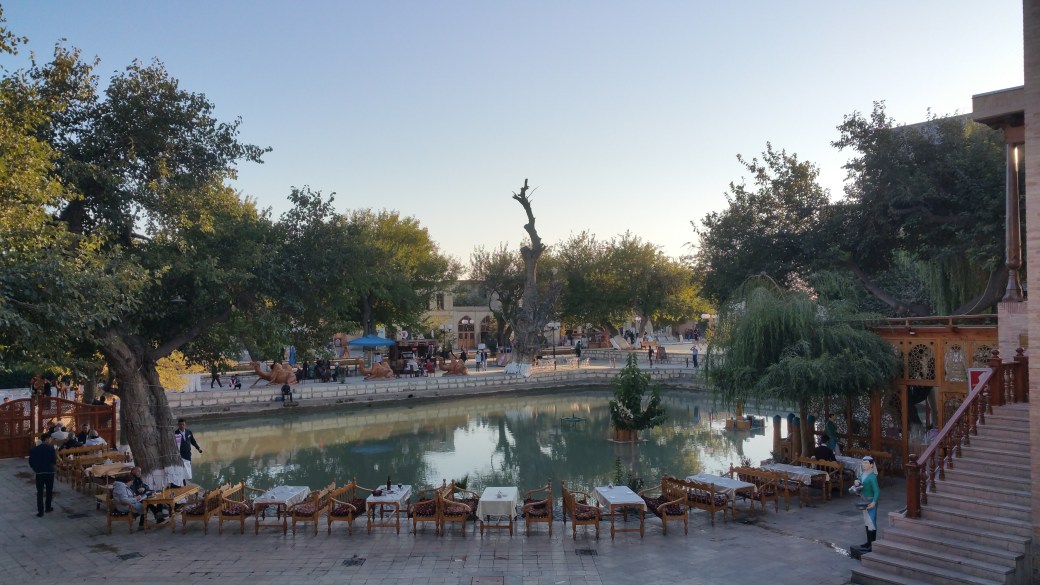
The Lyabi pool

Arriving in the early afternoon, Burkhara was a veritable oasis, and we found our way down a back street to the Lyabi House Hotel. The heart of the old town is immaculate (sweeping seems to be a national pastime for all) but it has a relaxed atmosphere; the locals sit out in dappled shade under the plane trees while a multiculture of tourists mill about photographing the beautiful tiled buildings, browsing the endless stalls of suzana embroidery, Uzbek carpets, miniature paintings, Rishtan pottery and ikat clothing, or repair at restaurant tables next to the Lyabi Hauz pool – an ancient water tank in the central square, home to white ducks swimming from miniature mosque style duck houses to the steps to waddle about with snoozing wiley cats or playful puppies. It’s a happy place, a little higher up the reality scale compared to Samarkand as the locals live amongst the treasured mosques and madrassas – albeit most of these former religious institutions now house the endless tourist trapping stalls of handicrafts. This reflects what has been described as the parallel Islam that is practiced in this part of Uzbekistan – hard line Islam is not tolerated and consequently the call to prayer is never heard in public.

29/09/17: Samarkand

Temperature: 7 – 17°C, a cool initially wet, then an overcast dull day – Cumulative distance travelled to date: 1,852 miles

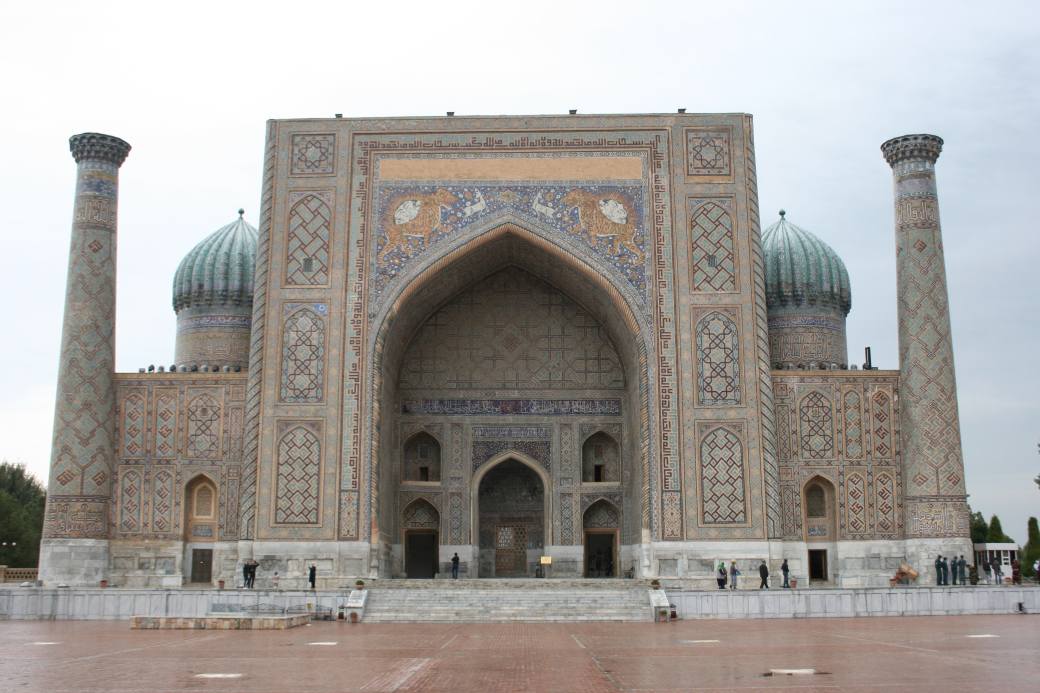
IMG_1999-minThe Registan – the Sher Dor Madrassa


The Mausoleum of Amir Timur, built in the 14th and 15th centuries

Murray had spent considerable time calculating just how much fuel we might need to change our route plan to take in Khiva, another key ancient Silk Road city in the north of the country, rather than taking the shorter southern route into Turkmenistan. With the promise of a diesel top up in Samarkand he estimated that we could comfortably make this journey and then head south through the Karakum desert to Ashgabat, the capital. He also established via his kindly Turkmen contact in Islamabad that we could obtain the necessary visas to get us into and out of Turkmenistan, often a stumbling block for people wishing to transit through this lesser known country.

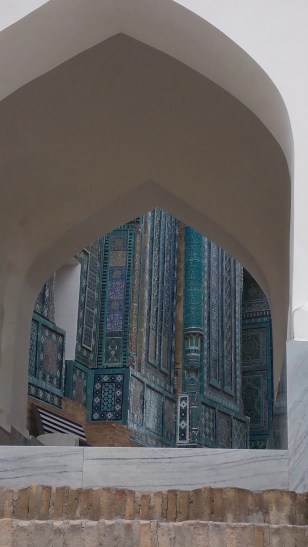
The Shah-i-Zinda – the Tomb of the Living King, referring to the most holy shrine, the tomb of Qusam ibn-Abbas, a cousin of the Prophet Mohammed. This avenue of mausolea, containing relatives of Temur and later those of his grandson Ulugbeck, was peaceful and moving drawing many pilgrims who quietly carried out their devotions.

After a day of sightseeing (never quite sure if we should be seeing the ‘site’ or the ‘sight’ – no doubt someone will tell me!) we collapsed back at our hotel to be shaken from our slumbers by a minor earth tremor. Something not so unusual for this region. In fact all the ancient monuments in this region have been renovated or rebuilt since the 1920s to date, due to dereliction and dilapidation caused either by neglect or earthquake or both (and the odd Red Army bomb), giving them all the air of a film set, slightly surreal and just a little too sterile to feel completely authentic. Nevertheless, they are still a sight to behold and testament to the craftsmanship still possible today.

The grand Registan, all of it has been restored over the last century. Photos from the early 1900s show it to be mere ruins. The restoration work is extraordinary but leaves it feeling a little sterile. The Russians added the bright blue cupola to the central building, causing outrage amongst the locals as it was not an authentic repair!

28/09/17: Tashkent – Samarkand

Travelling time: 09:30 – 13:30 – Distance: 206 miles – Temperature: 16 – 22°C

fullsizeoutput_dc5
“Hassan
We travel not for trafficking alone: 
By hotter winds our fiery hearts are fanned: 
For lust of knowing what should not be known
We make the golden journey to Samarkand.”
James Flecker, 1913

We had read and heard so much of the ancient Silk Road city of Samarkand that we were very excited to be on our way, leaving Tashkent on a clear and cool day, perfect for travelling.

The roads from Tashkent to Samarkand are very good, most probably to serve the slowly growing international tourist presence (notably groups of retired Europeans), and so we made far swifter progress than usual and arrived at our hotel in the early afternoon.

Throughout the journey there were regularly posted melon and fruit sellers on the sides of the road making punctuations of colour along the flat landscape, albeit bordered by the Turkestan Mountains to the southwest and the Nurota Hills to the northeast. The proximity to Afghanistan came as an unexpected realisation whilst map reading – our schooled knowledge of this region frequently shown to be lacking!  The cotton harvest was well underway and bands of cotton pickers were in evidence all long the route giving colour to the fields of fading crops.

We arrived in the remarkable city of Samarkand. While steeped in so much history it has the very modern feel of a new university city in the centre. However, beware anyone veering off the main roads as one quickly descends to the typical potholed Uzbek street and the real locales of the Uzbeks! Knowing that we only had one full day in Samarkand we spent the afternoon walking to the nearer sites and planning the best use of time for our visits the following day.

Samarkand holds some of the most impressive Islamic architecture in the world, brilliant with turquoise and lapis majolica tile work, and was most significantly the seat of Amir Temur, known historically in the West as Tamerlane – Timur the Lame. He was damaged in both his right arm and leg as a young man, attributed to an inauspicious encounter while stealing sheep!  Under Temur’s rule  Samarkand was the ancient capital city of a much larger Uzbekistan in the 14th and 15th centuries.

fullsizeoutput_d53

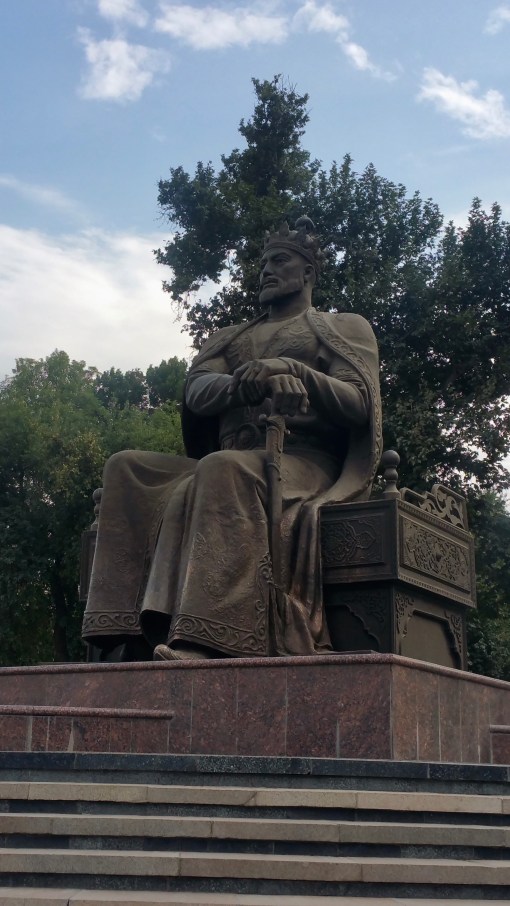
Amir Temur – the mighty Tatar

Temur deserves much more attention here but suffice to say in a nutshell, he was a thug of a Tatar warrior, ostensibly carrying the sword of Islam, who conquered huge swathes of land and peoples from Bagdad to Delhi paving the way for his immediate descendants to establish seats of great Islamic, philosophical and mathematical learning and ultimately founding the Mughal dynasty, ruling India until 1858.

Our hotel manager was very obliging with advice and recommendations, not only for restaurants but also for sharing the knowledge of a rare diesel pump hidden away in the back streets! Armed with a map for our site seeing the next day we headed out for a late supper at a nearby restaurant called Atlas Xan for possibly the best food in Uzbekistan – and certainly the best value. (Dining out well in Uzbekistan is possibly the best value of anywhere in the world that we’ve yet encountered.) While the young staff spoke not enough English for us to confidently order something recognisable from the Russian menu (I really should have bought an English-Russian dictionary and learnt the Cyrillic alphabet) they brought out the most knock dishes of perfectly cooked meat, grilled veg and salads. To finish there was much conferring between the three delightful waiters who announced they would bring what I thought they called ‘chocolate Fanta’. Not a fan of Fanta myself I thought it would be awful to decline such sweet attention and was soon thrilled receive the most prefect hot chocolate fondant pudding. It was heaven! (I hadn’t seen chocolate for weeks.)

What a result the outing had been, and such a successful surprise. Food and beers for two in a beautiful traditional yet modern Uzbek restaurant for the equivalent of £11.20!