03/10/17: Dashogus – Dervaza

Travelling time: 13:00 – 17:50 – Temperature: 3 – 15°C

20171003_210120

While being able to pay for the border fees in US Dollars (all 9 of them – we were expecting to pay a great deal more) we really needed to get hold of some Turkmen Manat so that we could buy much needed diesel having used up two of our precious jerry can supplies on the way from Samarkand to the border. Murray’s calculations had been absolutely spot on but we needed to refuel before heading into the depths of the Karakum desert.

We consulted the much loved Maps.me app and I found a number of banks in the heart of Dashogus which should have taken a VISA card and throw out the local currency. By the time we had entered the town it became obvious very quickly that there is an overwhelming police presence all out to ‘get ya’! Random car checks occur at intersections, traffic lights and periodically from behind trees for no apparent reason. Getting cash was not to be so straightforward but we met two men at an ATM who after a couple of phone calls told us that we needed to head to the local airport where there would be an obliging ATM. These men were very kind, helpful and self-deprecating of their lack of English – we were beyond grateful and charmed by their kindness.

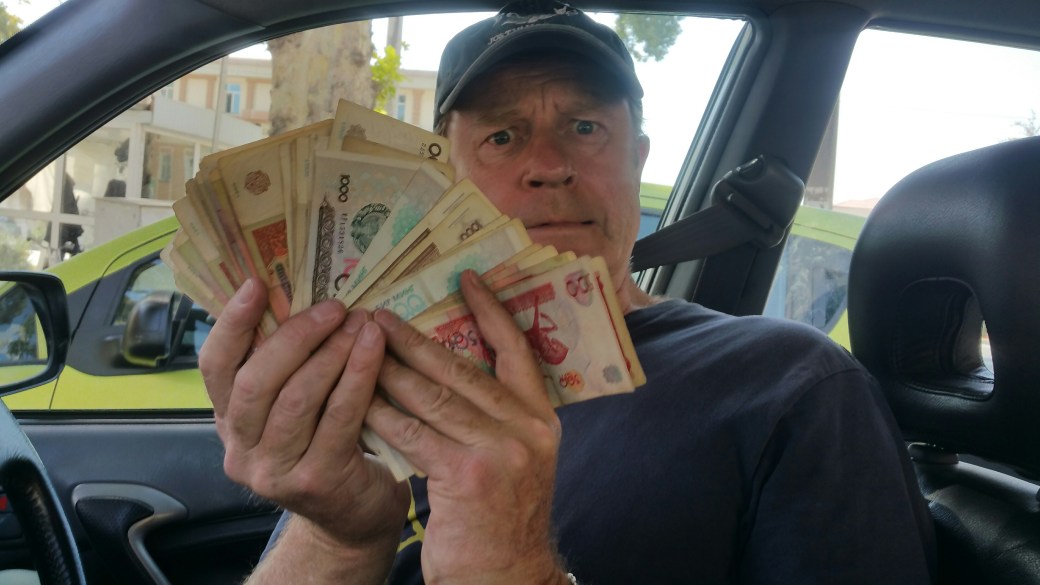
So, with less of a wad than our previous currency exchange we filled up at a very smart filling station, helped by another friendly Turkman who covertly filled our jerry cans while still in the boot behind my bag of Ikat fabric and some newly acquired water colour paintings of the silk route – really! Thankfully a good job was done and no diesel was spilt.

Now we were on the open road to our next destination, Dervaza and the Devil’s Crater – or the Door to Hell. We had about 220 miles to cover, half of this on great roads, the rest on terrible pitted tarmac. The flaming crater of Dervaza has become a national attraction although in reality it is a rather a damning indictment on the state of this nation, both in Soviet times and since independence. The crater appeared in the early 1970’s under tragic circumstances when a Russian drilling rig, prospecting for oil, literally fell foul and collapsed into a 70 meter sink hole, killing the rig crew and exposing a natural gas source. With the gas source leaking into the air it was thought that by setting it alight it would burn out. Some 45 years later it is still burning.

Deep in the Karakum desert and in the heart of the country, we had made arrangements through our contact in Tashkent to stay in the yurt of a local shepherd close to the Devil’s Crator. We arrived at the point on the ‘highway’ where we estimated the track off the road to the crater lay (just past a desolate railway crossing and a penal posting of police checkpoint. There was no one to be seen and the sun was beginning to set. After a long day this was a little anxious making as were about 180 miles from anywhere in either direction and we had no desire to travel on after dark. The desert winds must have whispered as about 10 minutes later our Russian speaking shepherd arrived in his 4 x 4 and we were able to followed him into the desert on what had become a reasonably defined track at this time of year. There we found a traditional yurt and lovely barbecue supper being prepared for us. What a fantastic moment!

20171003_184610

The panorama at sunset

We drove on to the burning crater some 400 meters from the yurt and watched the sun go down, accompanied by the eerie roar of the burning gas and the jumping plumes of flames licking the edges of the crater.

We were not totally alone. On the near horizon we saw a slightly odd sight of a pick-up truck with what looked like a large box affixed to the flat bed. It was in fact the transport and living arrangements for a wonderfully eccentric French couple whom had travelled from France, through Scandinavia and Russia to Central Asia in their self modified truck. Good on them!

As the sun had gone down the temperature dropped dramatically. We returned to the yurt and found a delicious supper and two delightful companions. A charming young British girl and her equally charming Turkmen guide were joining us for supper. It turned out that Natalie, from Wild Frontiers Travel was scoping the region for tailor made excursion for her more adventurous clients. Her guide was a one time Soviet war veteran with an amazing command of English and knowledge of literature and history from both the East and West. It made for a very entertaining evening of shared war stories between the Lieutenant and the Brigadier General, imparting of historical details of the region and great advice. We almost forgot to see the crater at its most beguiling, after dark.

03/10/17: Khiva – Dashoguz, Turkmenistan

Travelling time: 09:45 – 12:55

20171003_123331

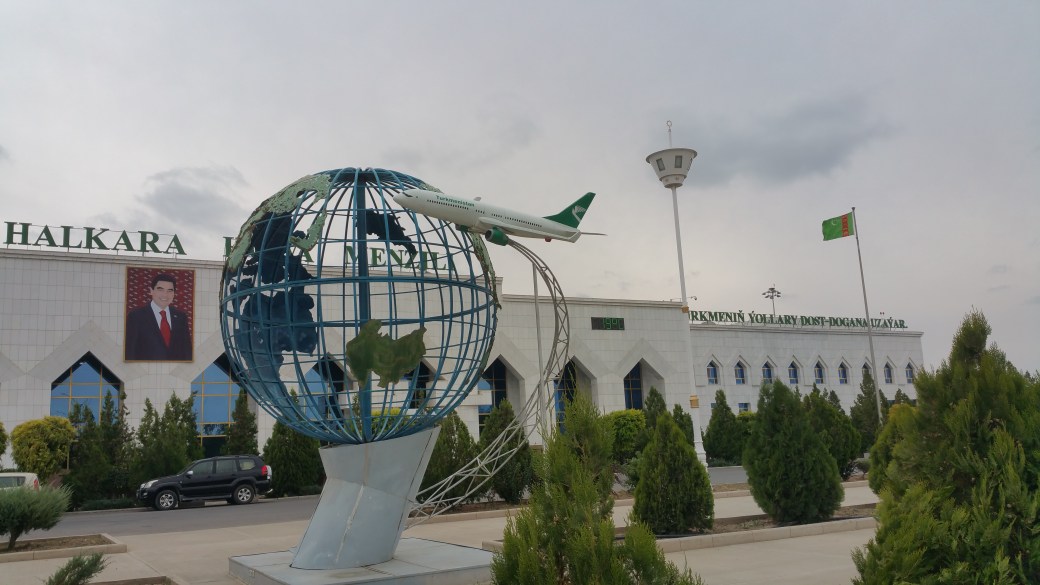
Dashogus Airport, one of many white marbled and gilded State buildings, flying the Turkmenistan flag and showing the President’s ubiquitous portrait.

The day ahead held a pretty big ask. Not only did we have reasonable stretch of road to cover, with unknown road conditions, we had what we anticipated to be the toughest of borders to cross, that of Turkmenistan. With all our research, reading of guidebooks, scouring blogs and travel websites of far flung places and conversations sought with fellow travellers and consulates, we expected this to be a long day.

We took advice from our host as to the best road to take to the border, that deemed to be through the tiny village of Shovot (Uzbekistan) and into Dashoguz in the north of Turkmensitan. This is a small and less frequently used crossing, compared to the busy border between Nukus and Konye-Urgench which draws tourists to the ancient city of Urgench, once the centre of the Muslim world and seat of the Khorezm empire in the 12th Century, a major trading post and city of learning. It was the scene of bloody Mongol battles with the arrival of Genghis Khan seeking revenge and the further spread of power and latterly decimated by Temur.

The road to the border post was unsurprisingly poor but Murray now had navigating the potholes in hand and we covered the 36 miles in just over an hour. We were one of the first to get to the crossing and made it out of Uzbekistan will relative ease, although it took a little time to persuade the senior immigration officer that we were simply visiting Uzbekistan as tourists and not on official business.

We were into Turkmenistan! Driving the 1 km between the posts our passports were checked by no less than three impossibly young Turkmen, clad in the uniform of conscripts, each of whom spoke a significant amount of English and welcomed us warmly. We were feeling quietly confident – none of the brusqueness of a police run state had yet been demonstrated. The official building at this small post was pleasingly orderly and filled with all flavours of officials, some in uniform, others not. We had our first glimpse of the pretty Turkmen national symbol and the first portrait of the President, with many more to come.

The process here was a little more exacting than crossing into Uzbekistan but having gone from one desk to another, with our official letter of invitation (which took three months to obtain before we left Islamabad!) as our licence to enter we were issued with a rare 10 day transit visa, and no mention of the usual compulsory guide for visits of longer that 3 days was mentioned.

On to customs to get the car into the country. This took a little longer and was somewhat more convoluted with no less than 5 stamps required from different officials. The result was a very smart green and white document, with the imposing green Turkmen star, and a definitive, no variation or deviation marked of our transit route through the country. So, here began the control, after a straight forward 2 hours of process and procedure.

02/10/17: Burkhara – Khiva


Longest days drive: 284 miles – Travel time: 07:00 – 13:40

20171002_162306

Leaving Burkhara shortly after first light our spirits sank as the road surface quickly developed into a dismal, diabolical sequence of craters, dust and deep, striated cracks. It was tough to navigate and maintain any speed. We began to question the sense of travelling north having covered 30 miles in the first hour, knowing it was a further 250 miles to reach Khiva. At that rate it was going to take 8 hours to get to the walled city and we wouldn’t make it until after dark. Notwithstanding the recommendation to see the city by moonlight, it didn’t do much for our humour.

All said we were committed to this route and pressed on. Thank God (and possibly the Chinese) the road changed dramatically at Gazli (which appeared to be a gas or oil related settlement) and we hit a super smooth, brand new two-lane highway! Spirits soared and we travelled on the best road since leaving Islamabad, clocking a steady 80 miles an hour for a good two hours.

With no one else around we could pit stop quite happily on the hard shoulder – or indeed in the middle of the road!

The highway ended and we travelled another 30km on relatively reasonable roads to get to the provincial city of Urgench and then 25 km further on to Khiva. After 5 and half hours of travelling we were slightly challenged to find the accommodation that had been booked for us. It transpired that it was situated slap bang in the middle of the ancient walled city in the Ichon Qala, and cars were not permitted, nor physically able, to enter. Murray disappeared for 20 minutes or so leaving me parked up in the middle of a bustling, frenetic bazaar, with the impatient minivan taxis reversing and hooting, picking up shoppers and school children all keen to be in the same place at the same time. He returned with the smiliest of fellows, a young English teacher cum hotelier who had room in his ‘inn’ – I wanted to think of it as a caravanserai, but this proved too romantic a notion. Unhooking the net that stretches across the back seat of the car (holding innumerable odds and ends for our travels) and piling up what I could to one side I squeezed myself on top of my bag of clothes and lay partially folded across the back so that our hotelier – who’s head peaked through the sun roof he was so tall! – directed us to his accommodation, the Islambek Hotel.

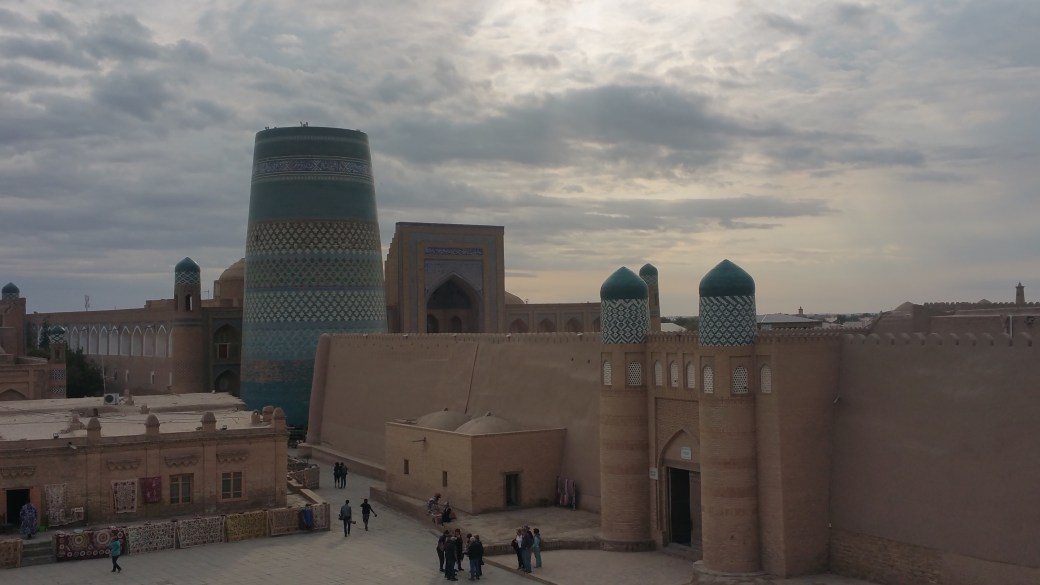
There we met a young and enthusiastic Swizz couple whom had bought a clapped out Land Cruiser in Tajikistan and were driving it home, having made some significant adjustments under the bonnet! We settled in to our very modest accommodation and left the car securely parked before heading off to see Khiva and all it promised to offer.

More mosques, minarets, majolica tiles and souvenirs (over indulgence of mosque and majolica, a malaise was beginning to take ahold!) . . . Ashgabat is calling but I fear we will be visiting Hell first . . .


01/10/17: Bukhara – “The mission is the drive. Anything else is a bonus”!

Cumulative distance travelled to date: 2,048 miles – Temperature: 16 – 18°C

fullsizeoutput_e17

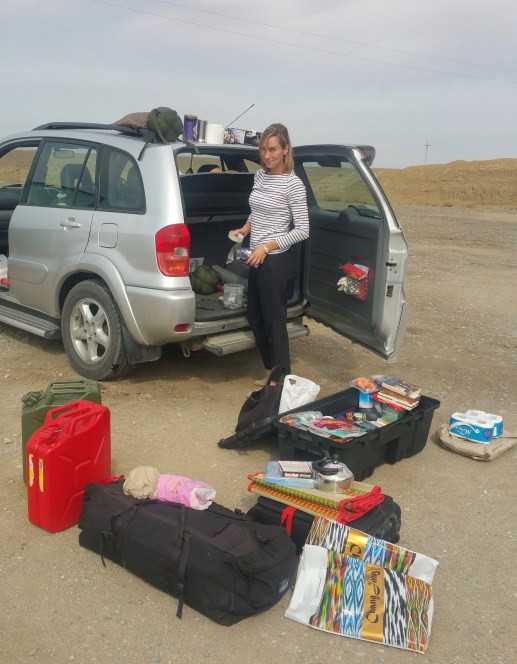
Prepping for the onward drive; jerry cans deployed, souvenirs ready to stow and ‘essentials’ brought forward (Fortnum’s coffee and loo rolls!!)

So, we were to have our bonus day in Burkhara. What a relief it was as we were both feeling a little jaded from the travelling. It had the feel of an Egyptian resort (sort of) but without the sea (obviously). We spent the day mooching through the streets and preparing for the next few days drive. It was during this time that I was duly reminded by Murray that while we were not working this was not a holiday but an adventure:

“The mission is the drive. Anything else is a bonus”

IMG_2080-min

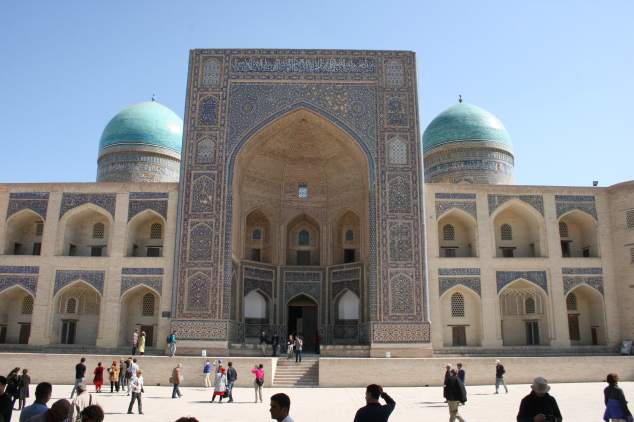
The Mir-i-Arab madrassa – another majolica tiled wonder


The mighty Ark – the seat of the Bukhara khanate and a fortress notoriously occupied by the megalomaniac Emir Nasrullah Khan in the 1800s. From here the Emir sealed the fate of the two British officers Stoddart and Connolly, players in the Great Game. They came to their end here, the first having been imprisoned after offending the Emir on arrival by not dismounting from his horse, the second who failed to secure a communique from Queen Victoria to explain that he was not spying for rival khanates of Kokand and Khiva. They were tossed in the vile bug-pit in the local jail for many months before being beheaded in the courtyard with the Ark.

In 1920 the Ark was bombed by the Red Army devastating much of it. Since then the majority of the outer walls have been renovated but 80% within remains in ruins. The areas that were not damaged now form a collection of museums and a back drop for the local artisans to sell their wares.

After some discussion and consultation of maps and more fuel calculations the plan was set to drive to Khiva and then to cross into Turkmenistan in the north and finally head south, via the Derweze fire crater – the gate to Hell – deep in the Karakum desert, to Ashgabat.

Over supper in Palov, the plov restaurant and into our second bottle of Uzbek dry red ‘Bagizagan’ (try saying that after one glass, three glasses promotes fits of giggles) we found out the name of the Kyrgyz warrior on horseback outside Jalalabat – and no, Nick, it wasn’t our old mate Genghis (nice try!), it was in fact the ‘Hero Kurmanbek’ Having Googled furiously on the very slow wifi while waiting for our order we were no closer to knowing exactly who he was but could surmise he wasn’t the recently dishonoured former Kyrgyz president (to the amusement of the waiter who suggested he be their Kyrgyz ‘Temur’), now in exile in Russia after some terrible misdemeanour.

We had absolutely no idea what was going on here but it was colourful and rather fun and seemed to be the Uzbek version of the ‘Sealed Knot’ – lots of amateurs dressed up in traditional garb posturing – or perhaps it was another ‘wedding’? (Jamie – we saw that bride again! She really gets around)

The end of the day . . . 


30/09/17: Samarkand – Bukhara

Travelling time: 09:30 – 13:20 – Distance: 173 miles

20170930_163822

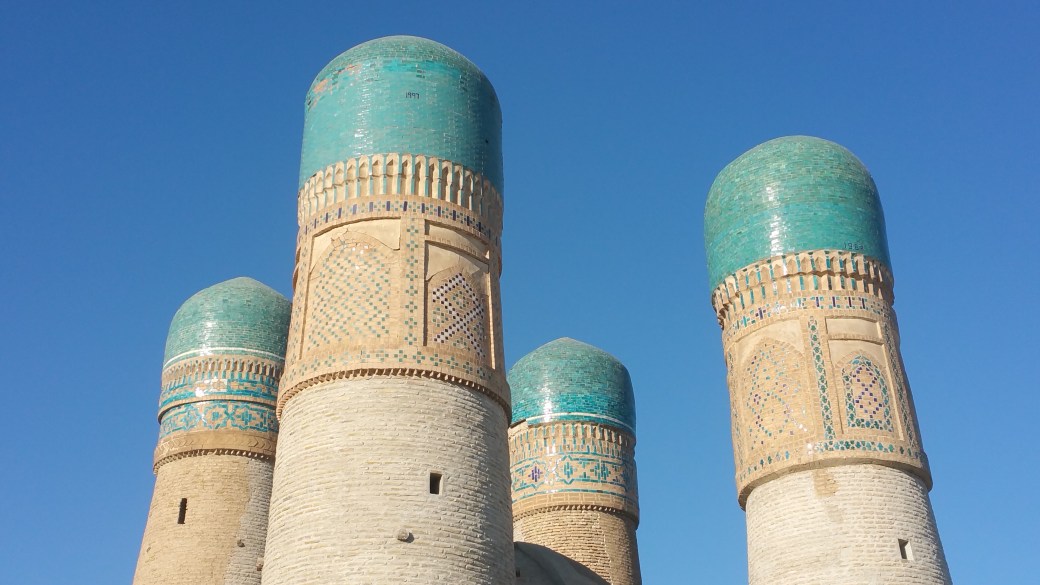
The Chor Minor – built in 1807 as a beautiful little gatehouse to a now defunct mosque.

We anticipated a drive of about 3-4 hours to get from Samarkand to Burkhara. Our questioning of the various members of hotel staff indicated that the journey could take anywhere between 3 and 6 hours. (For anyone wishing to drive this road, take note; the road around Ishtixon is the worst we have had to date, although at this time work is being done to improve it. Don’t be disheartened, it does improve eventually.) We shook rattled and rolled our way to Burkhara – not the most enjoyable of journeys at times. The poor old car took a bit of a beating.

20170930_173441

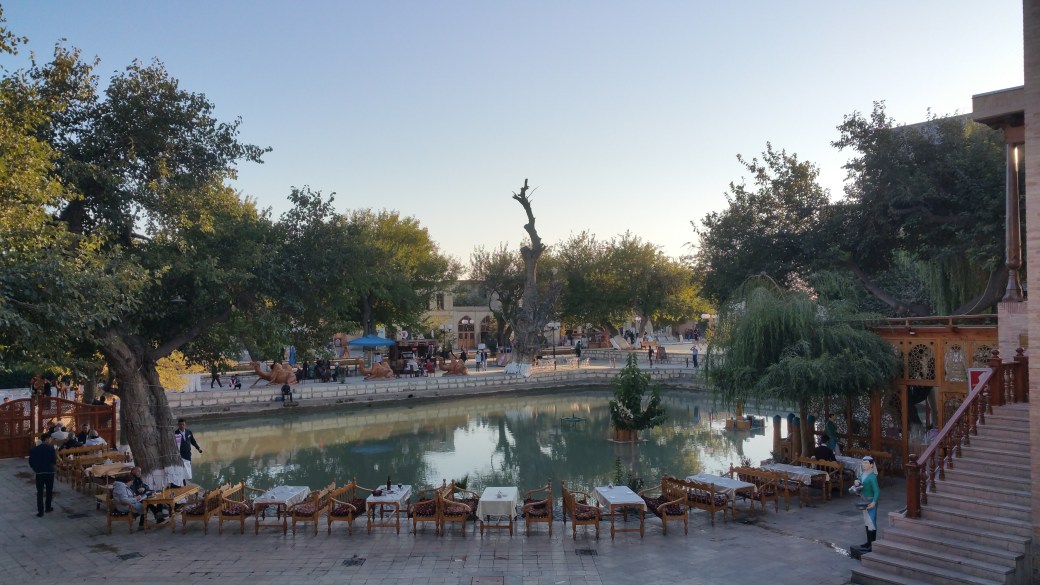
The Lyabi pool

Arriving in the early afternoon, Burkhara was a veritable oasis, and we found our way down a back street to the Lyabi House Hotel. The heart of the old town is immaculate (sweeping seems to be a national pastime for all) but it has a relaxed atmosphere; the locals sit out in dappled shade under the plane trees while a multiculture of tourists mill about photographing the beautiful tiled buildings, browsing the endless stalls of suzana embroidery, Uzbek carpets, miniature paintings, Rishtan pottery and ikat clothing, or repair at restaurant tables next to the Lyabi Hauz pool – an ancient water tank in the central square, home to white ducks swimming from miniature mosque style duck houses to the steps to waddle about with snoozing wiley cats or playful puppies. It’s a happy place, a little higher up the reality scale compared to Samarkand as the locals live amongst the treasured mosques and madrassas – albeit most of these former religious institutions now house the endless tourist trapping stalls of handicrafts. This reflects what has been described as the parallel Islam that is practiced in this part of Uzbekistan – hard line Islam is not tolerated and consequently the call to prayer is never heard in public.

29/09/17: Samarkand

Temperature: 7 – 17°C, a cool initially wet, then an overcast dull day – Cumulative distance travelled to date: 1,852 miles

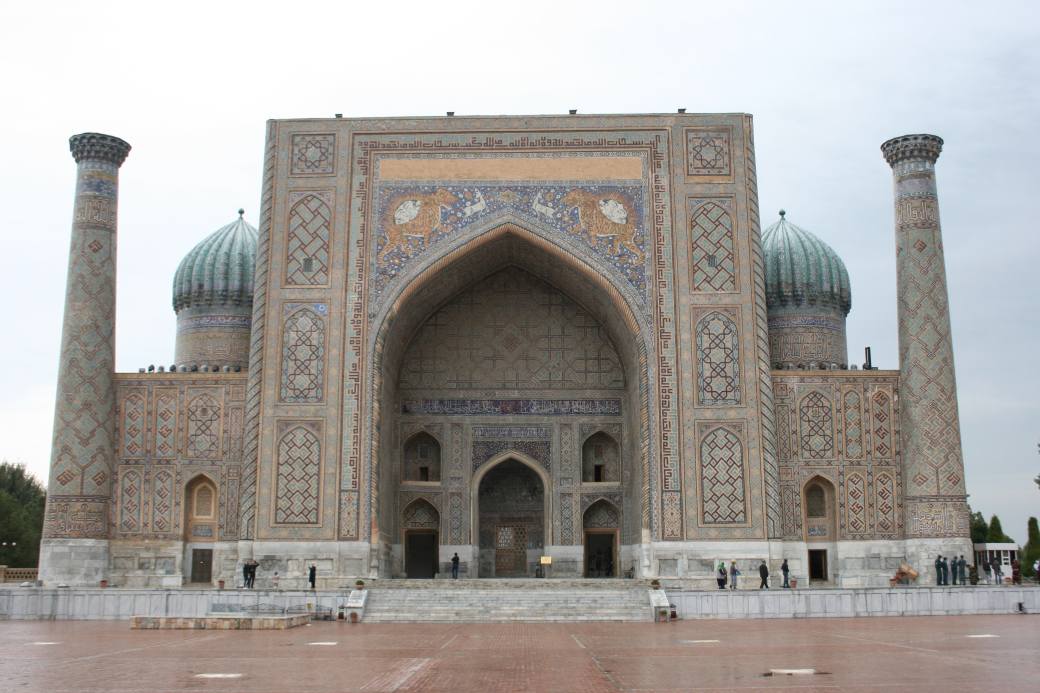
IMG_1999-minThe Registan – the Sher Dor Madrassa


The Mausoleum of Amir Timur, built in the 14th and 15th centuries

Murray had spent considerable time calculating just how much fuel we might need to change our route plan to take in Khiva, another key ancient Silk Road city in the north of the country, rather than taking the shorter southern route into Turkmenistan. With the promise of a diesel top up in Samarkand he estimated that we could comfortably make this journey and then head south through the Karakum desert to Ashgabat, the capital. He also established via his kindly Turkmen contact in Islamabad that we could obtain the necessary visas to get us into and out of Turkmenistan, often a stumbling block for people wishing to transit through this lesser known country.

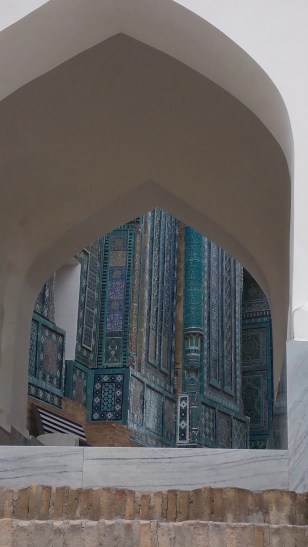
The Shah-i-Zinda – the Tomb of the Living King, referring to the most holy shrine, the tomb of Qusam ibn-Abbas, a cousin of the Prophet Mohammed. This avenue of mausolea, containing relatives of Temur and later those of his grandson Ulugbeck, was peaceful and moving drawing many pilgrims who quietly carried out their devotions.

After a day of sightseeing (never quite sure if we should be seeing the ‘site’ or the ‘sight’ – no doubt someone will tell me!) we collapsed back at our hotel to be shaken from our slumbers by a minor earth tremor. Something not so unusual for this region. In fact all the ancient monuments in this region have been renovated or rebuilt since the 1920s to date, due to dereliction and dilapidation caused either by neglect or earthquake or both (and the odd Red Army bomb), giving them all the air of a film set, slightly surreal and just a little too sterile to feel completely authentic. Nevertheless, they are still a sight to behold and testament to the craftsmanship still possible today.

The grand Registan, all of it has been restored over the last century. Photos from the early 1900s show it to be mere ruins. The restoration work is extraordinary but leaves it feeling a little sterile. The Russians added the bright blue cupola to the central building, causing outrage amongst the locals as it was not an authentic repair!

28/09/17: Tashkent – Samarkand

Travelling time: 09:30 – 13:30 – Distance: 206 miles – Temperature: 16 – 22°C

fullsizeoutput_dc5
“Hassan
We travel not for trafficking alone: 
By hotter winds our fiery hearts are fanned: 
For lust of knowing what should not be known
We make the golden journey to Samarkand.”
James Flecker, 1913

We had read and heard so much of the ancient Silk Road city of Samarkand that we were very excited to be on our way, leaving Tashkent on a clear and cool day, perfect for travelling.

The roads from Tashkent to Samarkand are very good, most probably to serve the slowly growing international tourist presence (notably groups of retired Europeans), and so we made far swifter progress than usual and arrived at our hotel in the early afternoon.

Throughout the journey there were regularly posted melon and fruit sellers on the sides of the road making punctuations of colour along the flat landscape, albeit bordered by the Turkestan Mountains to the southwest and the Nurota Hills to the northeast. The proximity to Afghanistan came as an unexpected realisation whilst map reading – our schooled knowledge of this region frequently shown to be lacking!  The cotton harvest was well underway and bands of cotton pickers were in evidence all long the route giving colour to the fields of fading crops.

We arrived in the remarkable city of Samarkand. While steeped in so much history it has the very modern feel of a new university city in the centre. However, beware anyone veering off the main roads as one quickly descends to the typical potholed Uzbek street and the real locales of the Uzbeks! Knowing that we only had one full day in Samarkand we spent the afternoon walking to the nearer sites and planning the best use of time for our visits the following day.

Samarkand holds some of the most impressive Islamic architecture in the world, brilliant with turquoise and lapis majolica tile work, and was most significantly the seat of Amir Temur, known historically in the West as Tamerlane – Timur the Lame. He was damaged in both his right arm and leg as a young man, attributed to an inauspicious encounter while stealing sheep!  Under Temur’s rule  Samarkand was the ancient capital city of a much larger Uzbekistan in the 14th and 15th centuries.

fullsizeoutput_d53

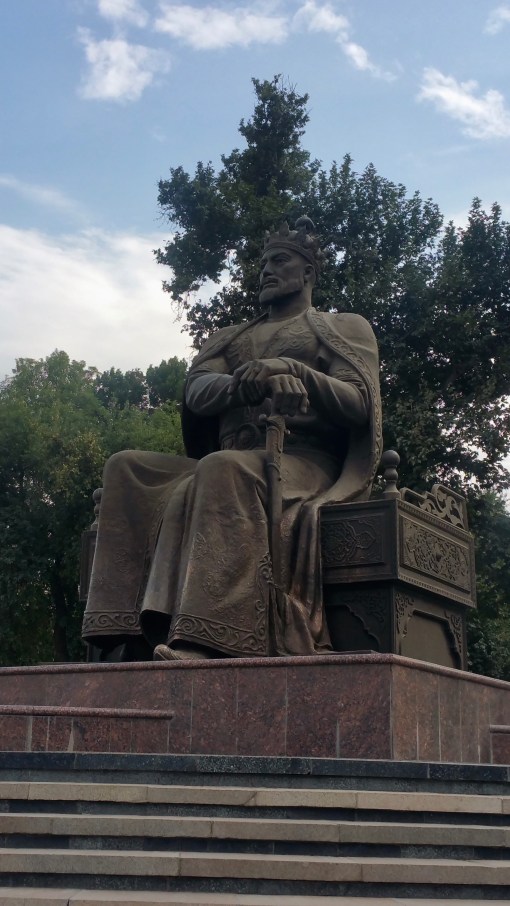
Amir Temur – the mighty Tatar

Temur deserves much more attention here but suffice to say in a nutshell, he was a thug of a Tatar warrior, ostensibly carrying the sword of Islam, who conquered huge swathes of land and peoples from Bagdad to Delhi paving the way for his immediate descendants to establish seats of great Islamic, philosophical and mathematical learning and ultimately founding the Mughal dynasty, ruling India until 1858.

Our hotel manager was very obliging with advice and recommendations, not only for restaurants but also for sharing the knowledge of a rare diesel pump hidden away in the back streets! Armed with a map for our site seeing the next day we headed out for a late supper at a nearby restaurant called Atlas Xan for possibly the best food in Uzbekistan – and certainly the best value. (Dining out well in Uzbekistan is possibly the best value of anywhere in the world that we’ve yet encountered.) While the young staff spoke not enough English for us to confidently order something recognisable from the Russian menu (I really should have bought an English-Russian dictionary and learnt the Cyrillic alphabet) they brought out the most knock dishes of perfectly cooked meat, grilled veg and salads. To finish there was much conferring between the three delightful waiters who announced they would bring what I thought they called ‘chocolate Fanta’. Not a fan of Fanta myself I thought it would be awful to decline such sweet attention and was soon thrilled receive the most prefect hot chocolate fondant pudding. It was heaven! (I hadn’t seen chocolate for weeks.)

What a result the outing had been, and such a successful surprise. Food and beers for two in a beautiful traditional yet modern Uzbek restaurant for the equivalent of £11.20!


27/09/17: Tashkent – a day off travelling

Cumulative distance travelled to date: 1,646 miles – Temperature: a cool 14°C and rain.

20170927_160600_resized

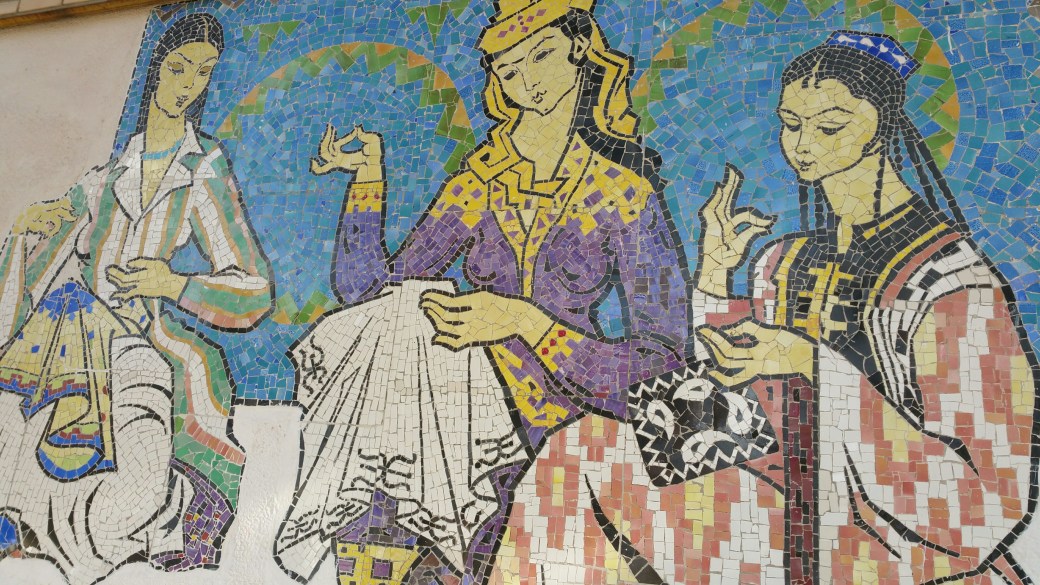
Mosaic tile work at the Uzbek Applied Art Museum in Tashkent

We woke to our first overcast day of the trip and the temperature had dropped significantly. Murray had made an arrangement to cross over the nearby border into Kazakhstan in order to buy diesel as it is virtually impossible to get it throughout Uzbekistan – something we knew about and had planned for by carrying extra fuel (equalling the combined weight of our children!) but we just wanted to top up the tank to be sure we could make it through the rest of our time in Central Asia without mishap.

I took up the offer of an escorted tour of the bustling ancient market area of the Churso to see how local Uzbeks shop. What a vibrant place this was. One could see immediately the melding of trades and wares from across Asia minor and major. More striking to my eye was the huge ethnic mix that makes up a diverse yet integrated Uzbek population. My escorts were long suffering, charming and good humoured as I trolled through the market trying to find traditional Uzbek fabric of the sort I’d imagined there might be.

We ended up in the vast covered food market selling fabulous fresh fruits and vegetables and finally into the meat and cheese hall, an immaculate and orderly area where all sorts of cuts were sold including endless varieties of offal and cuts of horse meat –  not so appealing to the average modern English palate!

With the latter part of the afternoon to ourselves we ventured out in the last few hours of daylight to explore some of the sites of the city.

The Railway Museum (truly, we had to do this; the quid pro quo for silk shopping)

The Holy Assumption Cathedral, the Russian Orthodox church.

Within the confines of the cathedral grounds there was an extraordinary hive of activity with an army of devout men and women cleaning every aspect of the church and its surrounding grounds, from the entrance tile work to the ornate chandeliers. Enormous  amounts of renovations were being carried out.


20170927_195049_resized

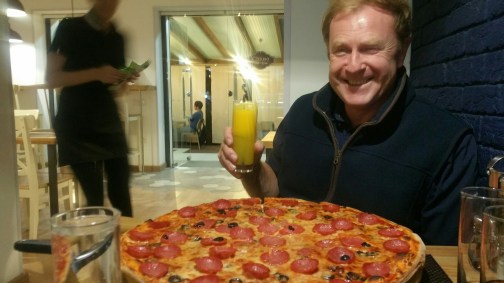
Man-sized pizza required after the excitement of the trains – we just weren’t expecting it to be quite so ‘man-sized’ (it served for lunch on the road the following day, too!).


26/09/17: Fergana – Tashkent (and Max’s 13th birthday!)

Distance travelled: 211 miles – Travelling time: 11:15 – 17:40 –  Temperature range: 14 – 26°C


20170927_110518_resized

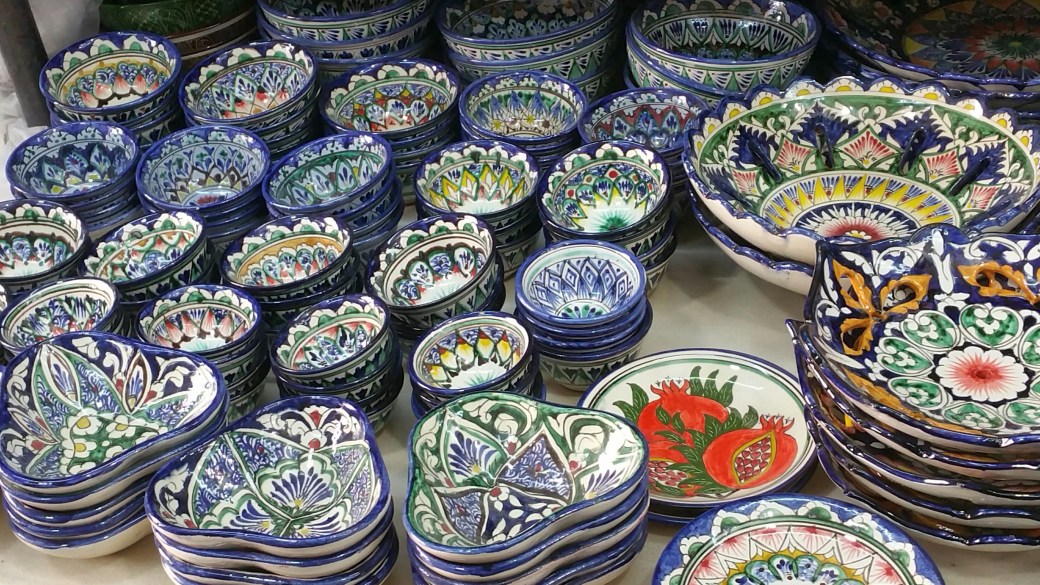
Typical Rishtan pottery, later we were to discover it is sold all over Uzbekistan!

We were still feeling pretty ropey from the effects of our night out in Osh but we got up and packed up in good time (sent Max a happy birthday email and so hoped we would be able to wish him a happy 13th birthday) and then went in pursuit of some local cash. A pursuit much easier to discuss than action! We were told we could use a Visa card to draw out US dollars that could then be converted to local Uzbek Som. The economy has in the past two weeks undergone a radical change. Until recently the value of the Som against foreign currency was incredibly volatile and most foreign exchange was carried out on the black market – apparently this was perfectly acceptable. The new system has created a stable currency of exactly 8000 Som to the US dollar, so about 11,000 Som to the British pound. In theory it meant we should have been able to go to any bank and get some local lucre.

Having gone from one sad and depressing ‘bank’ (they were pretty squalid institutional hallways with a tiny hatch through which one could see the bank teller – usually a rather attractive, well made up woman) to another seeing queues of languid locals we presumed were waiting for money transfers, we were about to give up.

Heading out of Fergana towards Margilan with our sights set on Rishtan, the pottery centre of Uzbekistan, we chanced upon a small Kapitol Bank with a Visa ATM. Hooray! From there I could take out US dollars and then convert them to Som in the bank. We were ‘local cash’ positive! The wads of notes were enormous.

20170926_112957_resized

At Rishtan we stopped and bought a couple of pieces of charming hand painted pottery from a roadside stall, prettily painted and of fine porcelain – this was M’s particular souvenir desire so he was happy (although only God knows whether they will survive the next 4000 miles in the car!). Heading north through Kokand we picked up the main road to Tashkent – another very bumpy road patched with panels of concrete and embellished with potholes.

We wound our way out of the Fergana Valley and up to the Kamchik Pass at 2,267m, between the Qutama Tizmasi mountains in the south west and the Chatkal Kirk mountains in the north east, scant kilometres from Tajikistan, on a road undergoing construction and repairs. Traffic was heavy and slow, with single lanes travelling in either direction and both sides desperate to overtake the gasping lorries and struggling older overloaded vehicles. There were the ubiquitous Ladas this time with their resilient rooves piled high with goods strapped on with rope, much of it comprising the recently picked balls of seed cotton – dense balls of fluffy fibre. I had come to appreciate the green variety of Lada – the same Kermit the Frog colour as my old school bike that my Father loving renovated for me!

The journey into the centre of Tashkent stretched our patience, the road surface is poor and the driving style nerve wracking. The bumper riders were out in force and travelling at speed – a hair raising combination – and little courtesy is shown on the roads. One had to have one’s wits finely tuned and two pairs of eyes were much needed to avoid incident. Coursing through the rush hour traffic we found our hotel in the centre of the city, which had very kindly been booked for us by the Defence Attachée in Tashkent whom along with his wife we were later to meet for dinner.

Our first impressions of Tashkent were encouraging. It is a modern cosmopolitan city with some Soviet undertones and many impressive new buildings on the main boulevards. The temperature in the evening was warm enough to allow us to enjoy delicious local cuisine outside on a smart terrace. We had a thoroughly lovely time with our hosts, the DA and his vivacious wife, who entertained us so kindly and we made arrangements to experience Tashkent properly the following day, not before we were able to Skype Max and wish him a happy birthday.

fullsizeoutput_dc4

Tashkent railway station at sunset. Warning: more on trains to follow . . .