Travelling time: 09:45 – 13:40 – Distance: 170 miles
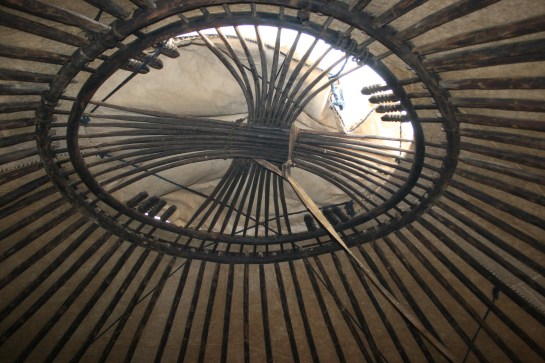
Looking up to the tunduk, the circular sky light cum vent in the centre of the yurt’s roof. It’s shape is depicted on the Kyrgyzstan flag
We had repaired a little merry after a jovial evening to our respective bed spaces the night before; Natalie and her guide to their tents, their driver to his car and us to the yurt. The shepherd had sensibly taken himself off home to his winter abode, to return shortly after first light. It had been a bitterly cold night in the yurt although we had more than enough sleeping bags and blankets to keep us warm.
Waking at 4 am with the cold and not wanting to move lest it make one any colder, it was time to reluctantly pop out for a pee. I am so glad I did. The night sky was magnificent. The stars shone brilliantly, the glow from the crater fires gave off an unearthly glow and the sand dunes were silhouetted by a near full moon. It was a magical scene and well worth the detour from Burkhara to the northern boarder.


The start of a new day . . a little creaky and not a little cold!


On the road to Ashgabat – fortunately we weren’t going at breakneck speed (unlike the majority of local drivers) when we came across this little train of camels noisily slurping and draining some rare rainwater.
After a tasty and long breakfast, prepared by the very hospitable shepherd, with our new friends we shared our plans (and coffee) and more travel advice and set off for the capital of Turkmenistan, Ashgabat. We had heard much of this relatively newly built city, clad with imported Italian marble and marked with golden monuments of Turkmenbashi, ‘Leader of the Turkmen’, the now deceased former president, Niyazov.
Ashgabat had been completely destroyed in 1948 by a massive earthquake killing two thirds of the country’s population, the extent of which was kept from the world during the Soviet period but it has since become recognised as and a national day of mourning on its anniversary on the 6th October. After independence in 1991 the old Soviet built city was razed and in its place gleaming white buildings, immaculately manicured parkland and striking monuments form the inner city.
It is forbidden to drive a dirty car in the city and so we dutifully stopped at a fortified cleaning station teaming with what we found to be men offering a taxi service into the city – it was a mistake to enter this compound with our windows down and quite remarkable how many heads can fit inside an open car window. The aroma this in itself manifested was almost knock out! It was the beginning of a bizarre experience.
With car now gleaming and rid of all signs of the desert and anything else that might have clung to the wheel arches on our trip thus far we timidly entered the city cautious of the many roadside police waving their striped batons and rigidly sticking to the varying speed limits – now recognisable to us from a distance by their silhouette of an enormous Russian style hat! Rows and rows of sterile white houses lead on to rows and towers of palatial city buildings. Had the day been sunny it would have been awe inspiringly dazzling but in the gloom of a grey sky it was slightly unnerving. While there were cars on the road there were so few people to be seen or signs of habitation in any of these monoliths.


We drove on, aware that photographing buildings not advisable as no government building should be photographed, nor certain monuments and since we were not sure what was what we (I) thought it best to stick to the advice we had been given.
We made our way to the hotel, the Ak Altyn, again, kindly arranged for us by the British Embassy, this time in Ashgabat and incidentally situated next door to our hotel. We unloaded, de-gunged from our desert excursion and made our way to say hello to the UK deputy Head of Mission and his assistant. It was great to be with a fellow Brit, albeit briefly. We then headed out to take in the city and find somewhere to eat. The city was a welcomed respite from the tourist towns and rural areas. A great restaurant was recommended to us, Köpetdag, named after the mountains beyond Ashgabat and bordering Iran. It’s a funky restaurant with a diverse international menu and very well run and popular with the well heeled city dwellers.
 Whitesides on the Road