Distance travelled: 211 miles – Travelling time: 11:15 – 17:40 – Temperature range: 14 – 26°C
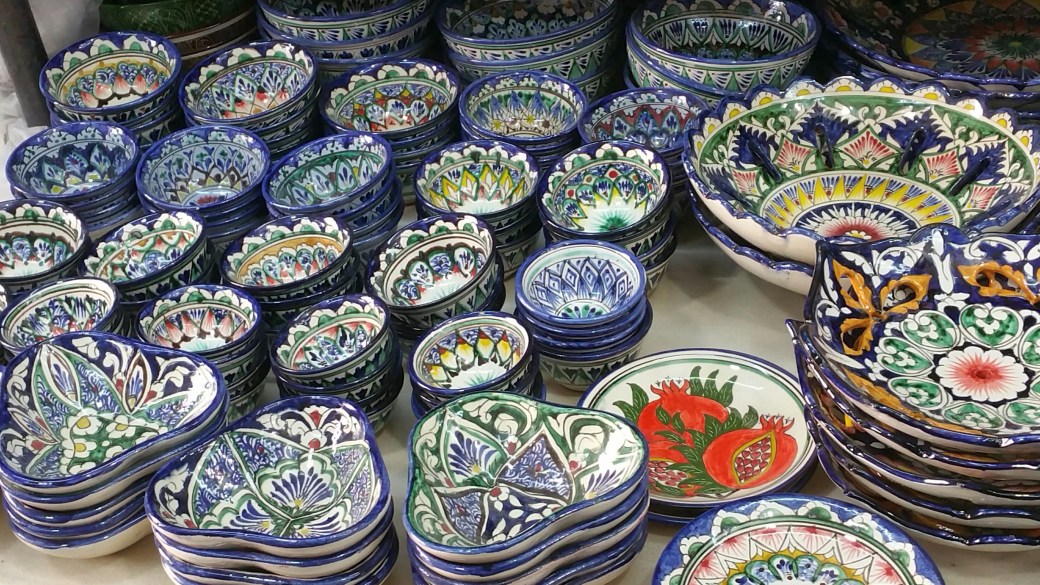
Typical Rishtan pottery, later we were to discover it is sold all over Uzbekistan!
We were still feeling pretty ropey from the effects of our night out in Osh but we got up and packed up in good time (sent Max a happy birthday email and so hoped we would be able to wish him a happy 13th birthday) and then went in pursuit of some local cash. A pursuit much easier to discuss than action! We were told we could use a Visa card to draw out US dollars that could then be converted to local Uzbek Som. The economy has in the past two weeks undergone a radical change. Until recently the value of the Som against foreign currency was incredibly volatile and most foreign exchange was carried out on the black market – apparently this was perfectly acceptable. The new system has created a stable currency of exactly 8000 Som to the US dollar, so about 11,000 Som to the British pound. In theory it meant we should have been able to go to any bank and get some local lucre.
Having gone from one sad and depressing ‘bank’ (they were pretty squalid institutional hallways with a tiny hatch through which one could see the bank teller – usually a rather attractive, well made up woman) to another seeing queues of languid locals we presumed were waiting for money transfers, we were about to give up.
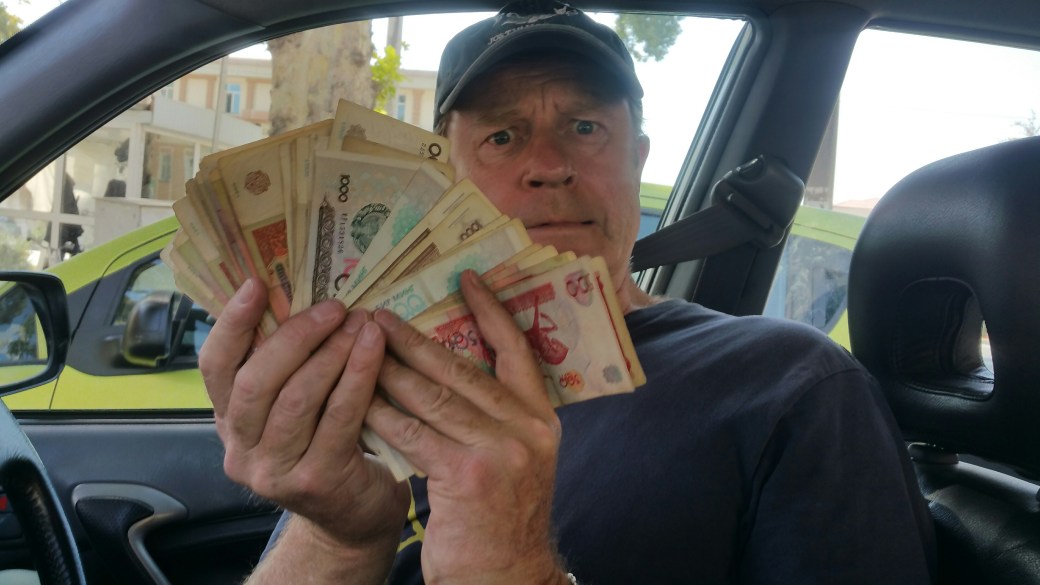
Heading out of Fergana towards Margilan with our sights set on Rishtan, the pottery centre of Uzbekistan, we chanced upon a small Kapitol Bank with a Visa ATM. Hooray! From there I could take out US dollars and then convert them to Som in the bank. We were ‘local cash’ positive! The wads of notes were enormous.
At Rishtan we stopped and bought a couple of pieces of charming hand painted pottery from a roadside stall, prettily painted and of fine porcelain – this was M’s particular souvenir desire so he was happy (although only God knows whether they will survive the next 4000 miles in the car!). Heading north through Kokand we picked up the main road to Tashkent – another very bumpy road patched with panels of concrete and embellished with potholes.


We wound our way out of the Fergana Valley and up to the Kamchik Pass at 2,267m, between the Qutama Tizmasi mountains in the south west and the Chatkal Kirk mountains in the north east, scant kilometres from Tajikistan, on a road undergoing construction and repairs. Traffic was heavy and slow, with single lanes travelling in either direction and both sides desperate to overtake the gasping lorries and struggling older overloaded vehicles. There were the ubiquitous Ladas this time with their resilient rooves piled high with goods strapped on with rope, much of it comprising the recently picked balls of seed cotton – dense balls of fluffy fibre. I had come to appreciate the green variety of Lada – the same Kermit the Frog colour as my old school bike that my Father loving renovated for me!


The journey into the centre of Tashkent stretched our patience, the road surface is poor and the driving style nerve wracking. The bumper riders were out in force and travelling at speed – a hair raising combination – and little courtesy is shown on the roads. One had to have one’s wits finely tuned and two pairs of eyes were much needed to avoid incident. Coursing through the rush hour traffic we found our hotel in the centre of the city, which had very kindly been booked for us by the Defence Attachée in Tashkent whom along with his wife we were later to meet for dinner.
Our first impressions of Tashkent were encouraging. It is a modern cosmopolitan city with some Soviet undertones and many impressive new buildings on the main boulevards. The temperature in the evening was warm enough to allow us to enjoy delicious local cuisine outside on a smart terrace. We had a thoroughly lovely time with our hosts, the DA and his vivacious wife, who entertained us so kindly and we made arrangements to experience Tashkent properly the following day, not before we were able to Skype Max and wish him a happy birthday.

Tashkent railway station at sunset. Warning: more on trains to follow . . .
 Whitesides on the Road