Temperature: 32°C
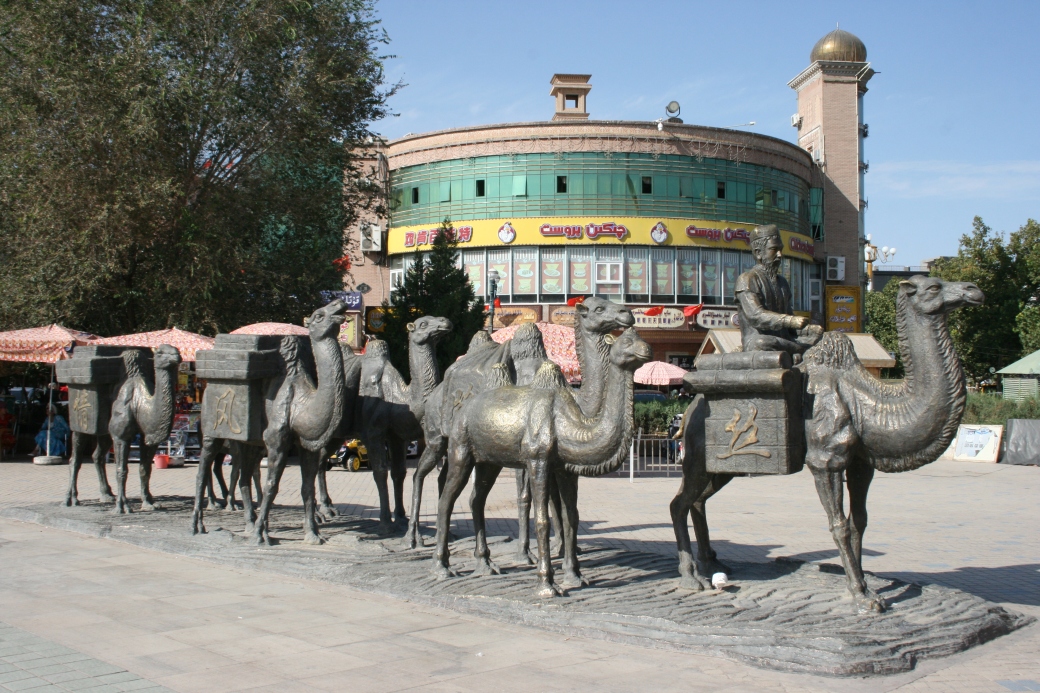
Kashgar variously works on local time, which is two hours ahead of Pakistan, or on Beijing time, which is three hours ahead. This leads to some confusion and is somewhat uncharacteristic of the Chinese way. Having arranged to meet David, our delightful State registered guide (and fixer), at 1000 we both overslept. We set off at a leisurely 1100 after a sampling some interesting local dishes for breakfast and went to explore the ancient city of Kashgar, known as the Pearl of the Silk Route, and sited at the very centre of the route.


Our first stop was the tomb of the Fragrant Imperial Concubine and a mausoleum of the Sufi saint, Abakh Hoja, and five generations of his family. From there we went on to the largest and oldest mosque in China. We were taken aback at how relatively small this was compared to the average mosque we were used to seeing in Pakistan. It was also covered in Chinese flags and CCTV, a staunch reminder that the State prevails. From there we toured the ancient walled city and wandered within its streets sampling freshly baked pasty-like snacks filled with a delicious mutton and herb mixture, warm breads baked with sesame and poppy seeds and ate the sweetest green figs. The streets were lined with craft goods, many in the form of local traditional Uyghur hats for men and women, and many goods made in Pakistan; a reminder that the modern day Silk Route is very much in existence with goods from all over the world on sale.


One very noticeable feature of the region is the overriding presence of the police. Every street is patrolled by a riot van with its siren continuously blaring and young police men and women at almost every street and alley intersection. They are generally mild mannered and appeared under utilised but they are a mark of the fear of an Islamic uprising and there to suppress any intent.


For us as visiting Westerners we felt at ease with the environment and the people, notwithstanding the police presence. On the surface the locals seem to be content and live easily side by side but one can’t help but thing that for the Uyghurs, who have to have their passes checked when they leave and enter the street in which they live, and to obtain passes to travel from one district to another or to buy fuel, there might just be some degree of repressed resentment.
Our day ended at a Chinese restaurant eating specially prepared Beijing duck and heaps of fantastically flavoured vegetables. Earlier in the day I had noticed some Chinese wines on sale. David very kindly bought an excellent bottle of ‘dry red wine’ for us to try, made to the east of Kashgar near Turpan. It really was very good!
 Whitesides on the Road
Loving the photos. Great narrative. But I really want to hear more about the Fragrant Imperial Concubine! Stay on track. Jamie
LikeLike